Revolutionary Theory Could Unravel Saturn's Enigmatic Moons
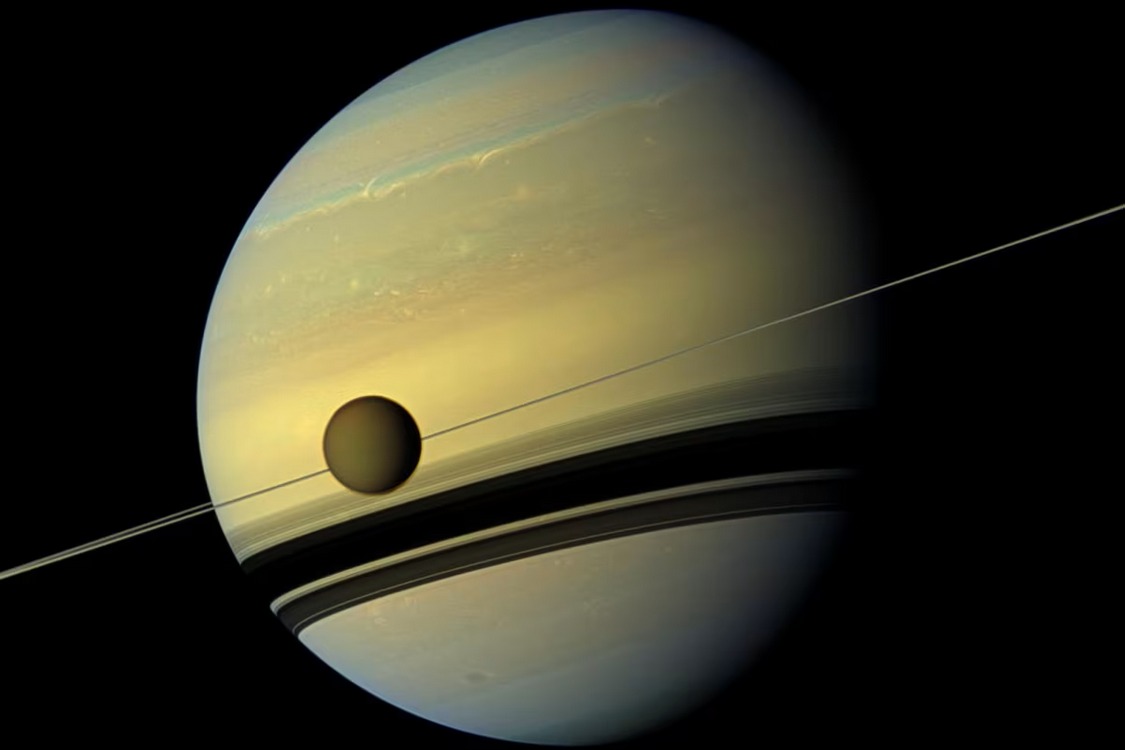
Recent research led by Matija Ćuk from the SETI Institute suggests that a collision between ancient moons may have resolved one of the solar system's enduring mysteries surrounding Saturn and its largest moon, Titan. This groundbreaking theory proposes that Titan's impressive size and Saturn's distinctive wobble could stem from a collision with another moon, offering new insights into the dynamics of our cosmic neighborhood.
A Collision in Time
According to Ćuk, the collision, which occurred around half a billion years ago, may have been a pivotal event. It is believed that this impact not only enlarged Titan but also perturbed some of Saturn's inner moons, potentially leading to the formation of Saturn's stunning rings approximately 100 million years ago. The research, which combines data from NASA's Cassini Probe and advanced computer simulations, is set to be published in The Planetary Science Journal, marking a significant contribution to our understanding of planetary science.
The Insights of Modern Astronomy
This new perspective comes at a time when astronomical research is rapidly evolving, particularly with the discoveries made possible by the James Webb Space Telescope. Ćuk’s theory adds to a growing body of evidence that continues to expand our knowledge of the solar system’s complexities. Until now, scientists primarily attributed Saturn's wobble to the gravitational influence of Neptune, but this latest research challenges previous assumptions, suggesting greater intricacies at play.
Expert Opinions Support the Theory
The academic community is taking notice; William B. Hubbard, professor emeritus of planetary sciences at the University of Arizona, has endorsed Ćuk's findings, asserting that this new theory holds stronger validity than earlier hypotheses. Similarly, Carl Murray, an emeritus professor at Queen Mary University of London, who was part of the Cassini team, described the collision hypothesis as “highly probable.” These endorsements underscore a collective excitement within the scientific community regarding the implications of this research.
The unveiling of Titan's mysterious origins not only enriches our understanding of Saturn but also serves as a reminder of how much we still have to learn about the vast universe that surrounds us. As technology and research methodologies advance, the prospect of discovering even more about our solar system becomes increasingly attainable.

