A Groundbreaking Theory Unearths the Secrets of Saturn's Moon Titan
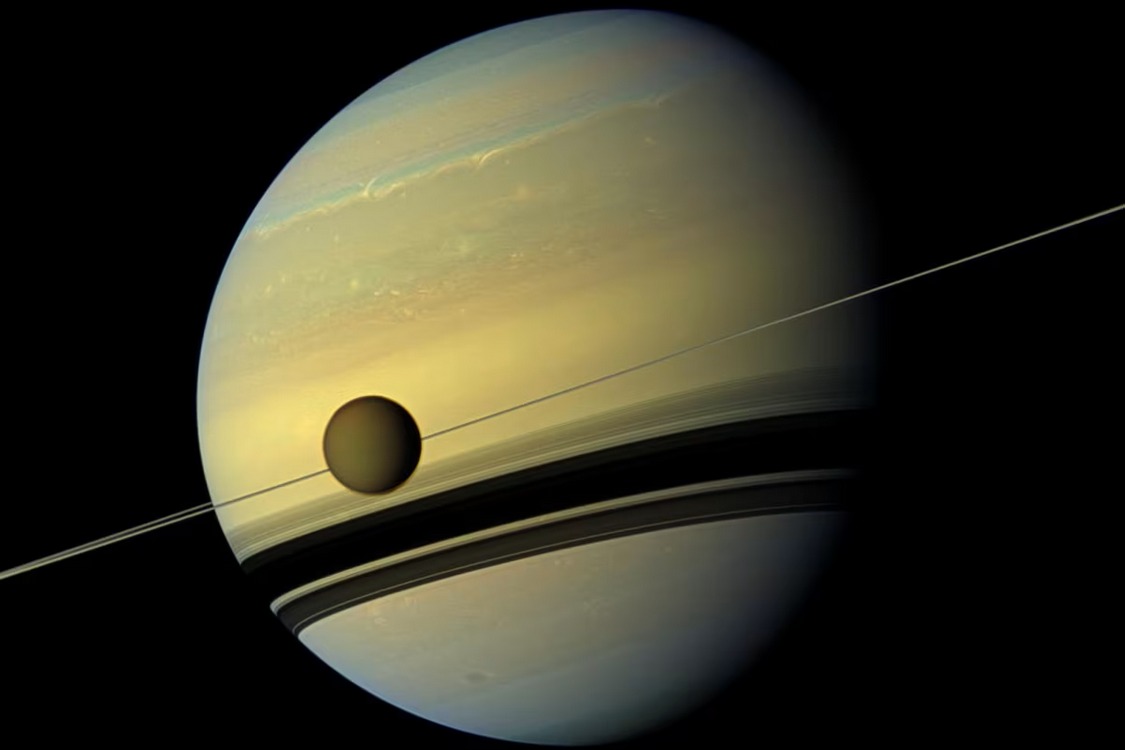
In a remarkable advancement in our understanding of the cosmos, researchers may have unraveled one of the solar system’s long-standing mysteries surrounding Titan, Saturn's largest moon. This newly proposed theory not only challenges existing beliefs about Titan’s formation but also enhances our comprehension of Saturn's behavior, including its tilt, wobble, and stunning rings.
New Insights from Stellar Science
Matija Ćuk, a research scientist at the SETI Institute, has put forth a compelling hypothesis suggesting that Titan's significant size may be attributed to a collision with an extra moon in its ancient past. By utilizing data from NASA’s Cassini Probe, which meticulously explored Saturn from 2004 to 2017, along with innovative computer simulations, Ćuk details how this monumental event potentially altered not only Titan's structure but also set a chain reaction affecting Saturn’s moons and rings.
The Collision That Could Change Everything
According to Ćuk, approximately half a billion years ago, a moon that could have been a precursor to Hyperion collided with Titan. This collision could explain Titan’s tremendous mass and gravitational pull, which impacts Saturn’s peculiar wobble and tilt. “This theory explains everything,” Ćuk asserted in an interview, emphasizing the significance of his findings that have now been accepted for publication in The Planetary Science Journal.
Revisiting Saturn’s Mysteries
Historically, scientists have grappled with the reasons behind Saturn’s wobble, initially attributing it to the orbital forces of Neptune. However, Cassini's data revealed discrepancies that prompted researchers to rethink existing theories. Previous hypotheses, such as the formation of Saturn's rings being linked to a lost moon, have now been refined by Ćuk’s model, which underscores an interplay of celestial events that could lead to a better understanding of planetary dynamics in our solar system.
Welcoming New Collaborations and Discoveries
The implications of Ćuk’s research extend beyond Titan, shedding light on the intricate relationships between celestial bodies in our solar system. Esteemed planetary scientists, including William B. Hubbard and Carl Murray, have examined the theory and found it to be highly plausible, marking a significant shift in astronomical thought.
As we continue to unveil the complexities of our universe, findings such as these not only enrich our collective knowledge but also inspire future explorations into the realms beyond Earth. The exciting prospect of further discoveries about Saturn and its moons suggests that there are still many secrets waiting to be uncovered, revealing just how much there is left to learn about our cosmic surroundings.

