
Why More Flagella Means Better Upstream Swimming: The Surprising Motility of Bacteria!
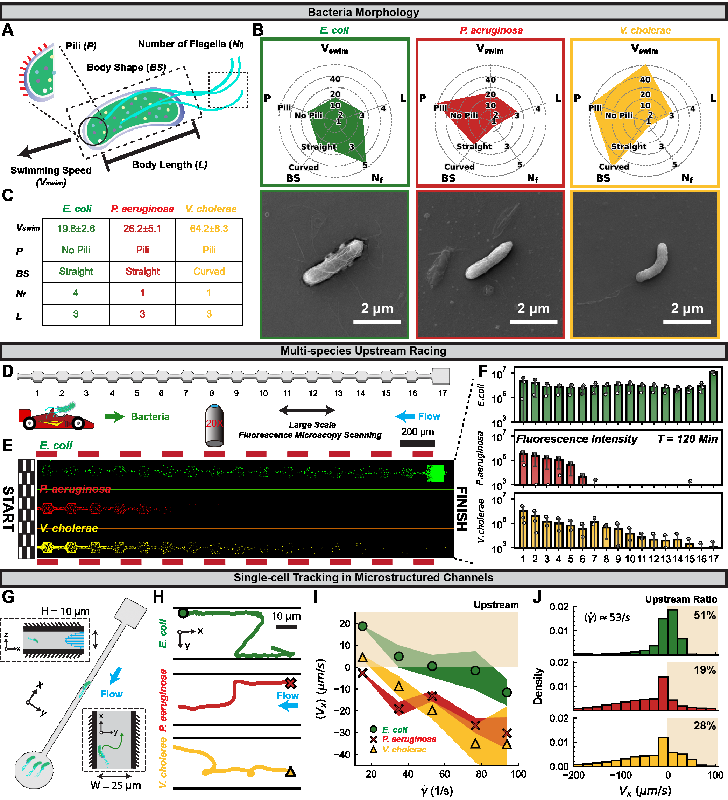
In a groundbreaking study, researchers at the University of Pennsylvania and their collaborators have unveiled significant insights into how certain bacteria achieve remarkable swimming abilities against fluid flows. This research could have profound implications for understanding bacterial pathogenesis and developing novel medical treatments.
Understanding Rheotaxis: The Bacteria's Navigational Skill
Bacteria often find themselves in environments with varying flow rates, such as the human body or natural water sources. The ability to swim upstream against these flows is known as rheotaxis and is crucial for their survival and colonization efforts. The study highlights how specific bacterial traits, particularly the number and arrangement of flagella—tail-like structures that propel bacteria—affect their ability to navigate upstream.
The Experiment: Competition Among Bacterial Species
The researchers conducted an innovative microfluidic control experiment where they observed three different species of bacteria: Escherichia coli (E. coli), Pseudomonas aeruginosa, and Vibrio cholerae. E. coli, equipped with multiple flagella arranged around its body, easily outperformed the others in upstream swimming, even against faster-swimming but single-flagellated species like V. cholerae. In fact, E. coli accumulated in upstream reservoirs at densities up to five orders of magnitude higher than its competitors, regardless of their swimming speed.
The Role of Multiflagellarity
One of the key findings of this research is that more flagella lead to increased efficiency in swimming against the current. As flagella numbers and lengths increase, so does the bacteria’s ability to navigate upstream. The concept of the “weathervane effect” was introduced, where increased flagella stabilize the bacteria’s position near surfaces and allow for better reorientation against flows.
Furthermore, enhanced rheotaxis was observed in strains of E. coli that were genetically modified to express more flagella. This implies that simply increasing flagellar abundance significantly influences swimming behavior, irrespective of swimming speed. The researchers found that the enhanced performance was due more to the ability to turn effectively against the flow than to how fast the bacteria could swim.
Implications for Disease and Treatment
The implications of this study extend into clinical settings, particularly for understanding infections like urinary tract infections, where E. coli is a common culprit. By elucidating how pathogenic bacteria navigate fluid flows, new pathways for developing treatments to combat these infections can be explored. Targeting the physical properties of bacterial motility might offer an alternative strategy, especially in scenarios where antibiotics prove ineffective.
Conclusion: A New Perspective on Bacterial Behavior
This research shifts our understanding of bacterial movement by framing the structural attributes, such as flagellar arrangement, as critical components of their navigation strategy. It highlights a broader narrative: that in the microscopic world, more isn't just better; it's fundamentally transformative. Bacteria that excel in multiflagellarity not only swim faster but accomplish tasks that could be vital for their survival in challenging environments.
The study stands as a testament to the interplay between bacterial morphology and their ecological adaptability, encouraging deeper investigations into microbial life and its implications for health.
Authors: Ran Tao, Nathaniel C. Esteves, Wanho Lee, Lauren Altman, Liuni Chen, David Gao, Ling Li, Yongsam Kim, Jun Zhu, Sookkyung Lim, and Arnold J. T. M. Mathijssen.




