
Unveiling the Token-Energy Law: A Breakthrough in Energy Efficiency for Large Language Model Inference
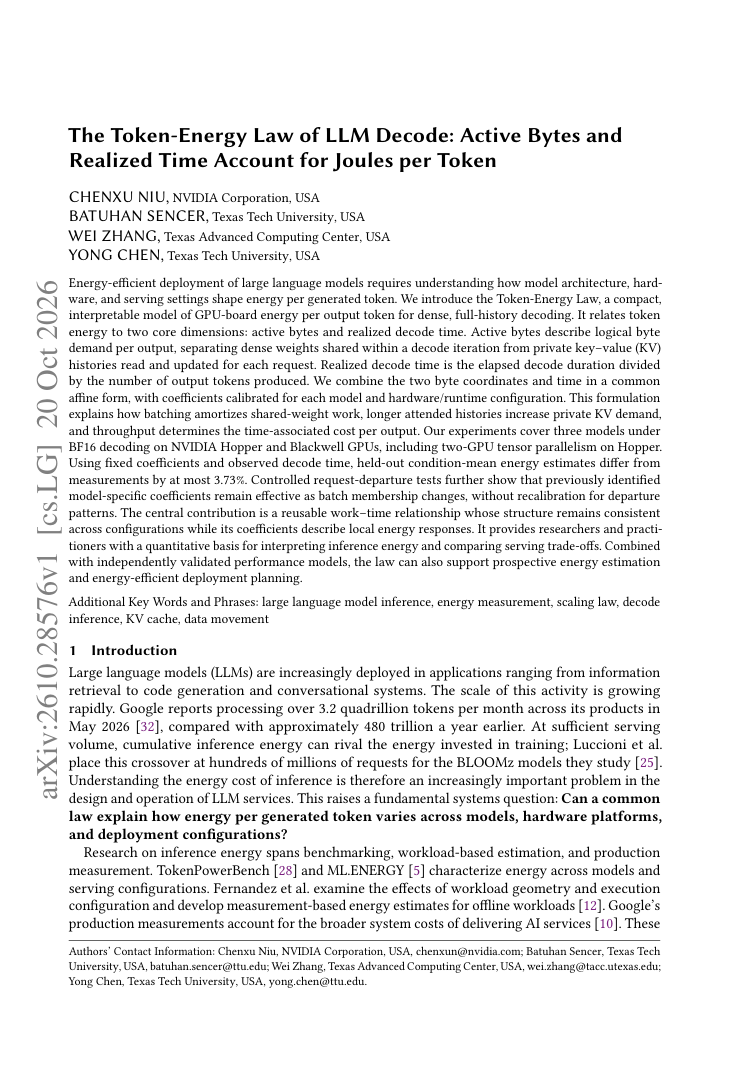
In the rapidly evolving landscape of artificial intelligence, energy efficiency remains a crucial challenge, especially for large language models (LLMs) that are central to numerous applications, from web search to customer support. A recent research paper by Chenxu Niu, Batuhan Sencer, Wei Zhang, and Yong Chen introduces a transformative concept referred to as the Token-Energy Law. This novel framework provides significant insights into energy consumption during decodes, an essential operation for LLMs.
The Token-Energy Law Explained
The Token-Energy Law offers a concise model that articulates how the energy used by GPU boards per output token can be quantified. Central to this model are two key components: active bytes and realized decode time. Active bytes represent the logical byte demands that different requests make for each output, while realized decode time measures how long it takes to generate these outputs. By combining these two aspects, the Token-Energy Law illuminates the interplay between model architecture, hardware, and operational strategies in determining energy costs.
Understanding Active Bytes and Realized Decode Time
Active bytes are derived from the shared weights used across outputs and the private histories maintained for each request. This differentiation is critical as it allows for a clearer understanding of energy allocation during computation. On the other hand, realized decode time is straightforward—it simply refers to the total time taken to produce a certain number of tokens divided by the count of those tokens. The interplay of these two factors provides a robust representation of energy dynamics in LLM inference.
Key Findings and Implications
The authors conducted extensive experiments using various models on NVIDIA GPUs, which revealed that their energy estimates closely matched actual measurements. Specifically, the predictions derived from the Token-Energy Law showed discrepancies of less than 4% from the observed energy consumption, marking a significant achievement in energy forecasting accuracy. Such precision not only validates the Token-Energy Law but also positions it as a vital tool for researchers and practitioners looking to optimize energy usage in AI systems.
Future Applications and Importance
The implications of the Token-Energy Law extend beyond mere energy calculations. Its framework can facilitate energy-efficient deployment strategies, allowing organizations to make informed decisions about resource allocation in LLM tasks. As we advance toward an era where AI systems generate immense amounts of data, models like this will be pivotal in ensuring sustainable and efficient technology deployment.
In conclusion, the Token-Energy Law serves as a groundbreaking step in understanding and manipulating the energy costs associated with large language model inference. It equips developers and researchers with the necessary tools to optimize operational workflows while addressing one of the pressing challenges in AI—energy consumption.
Authors: Chenxu Niu, Batuhan Sencer, Wei Zhang, Yong Chen


