
Unveiling Quant-Arena: The Groundbreaking Benchmarking System for Trading AI
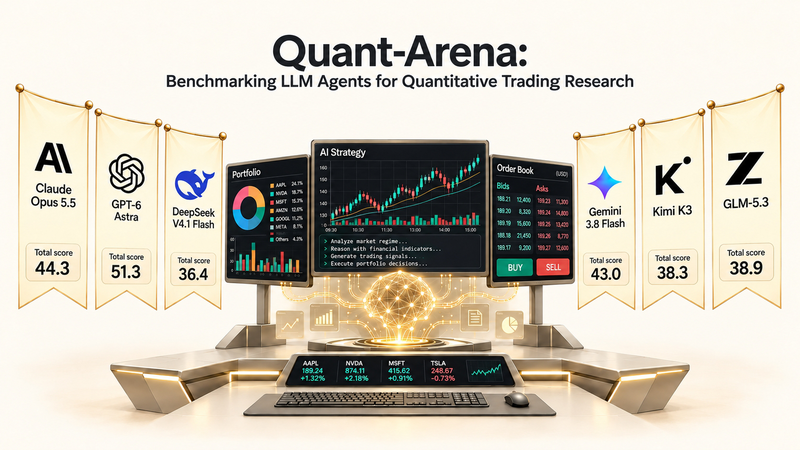
A recent research paper introduces a transformative benchmarking platform named Quant-Arena, designed to evaluate the capabilities of large language models (LLMs) in the realm of quantitative trading. The research team hailing from Nevers Lab, Einsia.AI, consists of prominent authors including Houde Qian, Zheng Jiang, and Calvin Xiao, aiming to assess how effectively these AI models can navigate the complexities of financial markets.
The Quantitative Research Loop
In the world of quantitative trading, researchers cycle through a process: proposing market hypotheses, implementing them, testing against historical data, and deciding what strategies to retain. Traditional evaluation metrics focus on fragmented components—like scoring formulas or individual trading decisions. Quant-Arena, however, presents a different approach. It assesses whether LLMs can complete this iterative cycle effectively, producing long-lasting strategies that extend beyond the proposed research period.
How Quant-Arena Works
Quant-Arena uses real market data from the Chinese A-share market spanning 2022 to 2024. Its mechanism is straightforward yet cutting-edge: AI models generate features and stock-scoring code from raw order and trade data. They submit one frozen strategy after iterative testing, which is then evaluated on out-of-sample data from 2024, devoid of any further feedback. By implementing stringent trading rules and cost considerations, the platform reflects actual market conditions.
Performance Insights and Model Comparison
The research evaluated nine leading AI models, including the highly-ranked GPT-6 Astra. Astonishingly, no model outperformed the market average during the 2024 assessment period. The models typically ranked stocks with some skill, yet the highest-ranked stocks often yielded lower returns than those ranked in lower deciles. This reveals a critical insight: predictive ranking alone doesn’t guarantee investment success.
The Impact of Iteration and Reasoning Effort
One striking finding from the experiments is that iterative approaches raised overall scores for all nine models, yet the sealed-period annualized return was only higher for four models. This suggests that while iteration can refine a strategy, it doesn’t automatically translate to better investment outcomes. The research highlights the importance of timing and market conditions, as illustrated by the Astra model, which predominantly profited by remaining out of the market during downturns.
Future of Quantitative Trading with AI
Quant-Arena presents an open platform inviting contributions from various models under the same evaluation framework. By bridging the gap between AI-driven hypothesis generation and actual trading performance, it sets a new standard in the field of quantitative trading. As AI continues to evolve, tools like Quant-Arena will be crucial in determining how effectively these algorithms can interpret and act in the dynamic and often unpredictable financial markets.
Overall, this research not only opens avenues for innovative trading strategies but also emphasizes the need for comprehensive evaluation methods to truly gauge the effectiveness of AI in financial applications.
Authors: Houde Qian, Zheng Jiang, Wenyi Li, Chenxi Xu, Xinjie Lin, Yuzhao Peng, Ruoyu Han, Youjie Zheng, Kaisen Yang, Qinhuai Na, You Fu, Calvin Xiao


