
Unveiling Market Dynamics: The Surprising Insights of State-Space Models in Limit Order Books
In the fast-paced world of financial trading, understanding market behavior is crucial for making informed decisions. Recent research from the British Open-ended Learning and Discovery Lab and the University of California, Los Angeles has shed new light on how state-space models can accurately simulate and interpret the complex flows of limit order books (LOBs), revealing important dynamics that were previously obscured.
Understanding Limit Order Books
A limit order book is essentially a real-time record of buy and sell orders for a particular stock, constantly updated with every transaction in the stock market. The data generated from limit order books is immense, making it an ideal subject for machine learning applications. Yet, the challenge has been that traditional models struggle to interpret this data effectively, leading to inefficiencies and potential trading errors.
The Breakthrough of Autoregressive Foundation Models
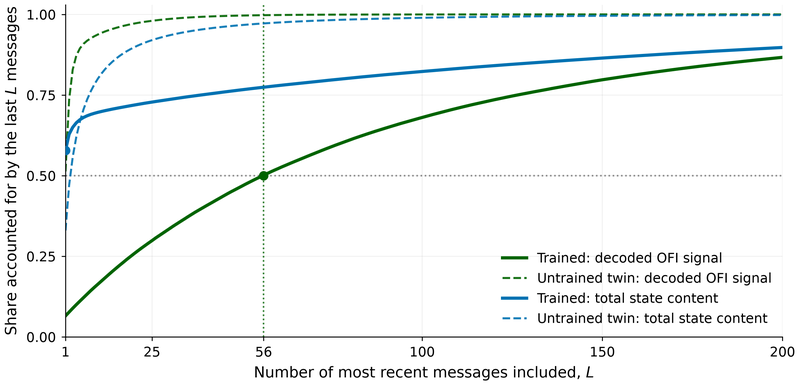
The research presents an 8.2 million-parameter model called Mamba-3, which was designed to process the intricate details of LOB data. Unlike conventional models that offer black-box predictions, this state-space model is capable of building an internal representation of the market's dynamics based solely on the message flow of order books. This ability to decode order-flow imbalance (OFI), a vital indicator of market sentiment, marks a significant advancement in how predictive models interpret trading environments.
Decoding Market Signals with Precision
According to the findings, the Mamba-3 model can predict order-flow imbalance with a remarkable accuracy rate (R² ≈ 0.59), which surpasses traditional benchmarks. This suggests that the model not only understands current market dynamics but is also generalizable across different stocks, even those it has never encountered before. This cross-stock generalization is especially valuable as it opens up avenues for scalability in trading strategies.
A Causally Steerable Model
One of the most groundbreaking aspects of this research is the model's ability to be "causally steerable." By manipulating the internal representation of factors like order-flow and trading volume, the model can adjust its predictions in a predictable and controlled manner. This feature could potentially allow traders to simulate various scenarios and assess the likely impact of different trading strategies.
Practical Implications for High-Frequency Trading
The implications of this research extend beyond academic interest; they have significant practical applications, especially in high-frequency trading environments. By providing a clearer understanding of market dynamics, traders can make faster, more informed decisions, reducing the risks associated with market volatility.
Conclusion: A New Era for Financial Models
As financial markets continue to evolve, the integration of advanced modeling techniques such as the state-space model developed in this research represents a promising step forward. By unveiling the inner workings of limit order books and improving our understanding of market microstructure, researchers are paving the way for more reliable trading mechanisms that could transform the financial landscape.
Authors: Valentin Mohl, Alexandre Bismuth, Aramis Marti-Shahandeh, George Nigmatulin, Kang Li, Stefan Zohren, Jakob Foerster, Mihai Cucuringu, Anisoara Calinescu


