
Unraveling the Quantum Mechanics of West Nile Virus Spread: The Game of Life in Action
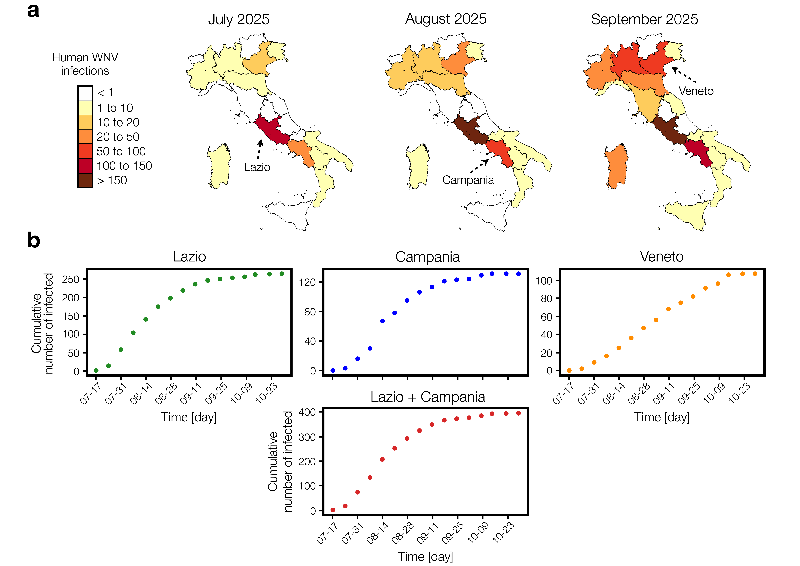
In a groundbreaking study, researchers from Italy have harnessed a quantum approach to model the outbreak of the West Nile virus (WNV) across various regions, revealing significant insights into how environmental factors influence disease dynamics. The study, led by Andrea Fontana and his team, utilizes a quantum version of the Game of Life—a cellular automaton model—to simulate the epidemic's progression during the summer of 2025.
The Significance of the West Nile Virus in Italy
The West Nile virus, primarily transmitted by Culex pipiens mosquitoes, has seen alarming increases in outbreaks within Italy, particularly in areas such as Lazio, Campania, and Veneto. This research aims to understand the underlying mechanisms that contribute to the disease's spread, especially given the backdrop of changing climatic and ecological conditions that can affect mosquito populations.
Innovative Modeling Approach: Quantum Game of Life
The researchers took a novel approach by applying the generalized semi-classical Game of Life model (gSCGOL), which embodies principles of quantum mechanics, to represent human and mosquito interactions. In this model, individual cells on a two-dimensional grid represent either humans or mosquitoes, evolving over time based on specific probabilistic rules that simulate birth, death, and movement patterns.
This approach not only captures the interaction of mosquitoes with humans but also allows for the examination of how different factors, such as humidity and temperature, can influence the spread of the virus. By adjusting parameters like the birth and removal rates of mosquitoes, the model closely aligns with actual reported infection curves, demonstrating its utility in predicting epidemic outcomes.
Key Findings and Implications
The research revealed an impressive correlation between the model's predictions and real-time epidemiological data. Notably, the fitted parameters indicated that variations in temperature and humidity levels significantly impact mosquito populations and, consequently, the infection rates of WNV. For instance, higher temperatures correlated with increased mosquito breeding rates, while lower humidity levels appeared to decrease mosquito abundance.
This study could serve as a critical tool for public health officials and decision-makers. By simulating various environmental scenarios, the gSCGOL model can help in devising effective strategies for mosquito control and disease mitigation, addressing public health concerns amid a backdrop of climate change.
A Step Towards Future Applications
Beyond WNV, the research underscores the potential of utilizing quantum models to explore other vector-borne diseases such as Dengue and Zika virus, which also rely on complex ecological and environmental interactions. As climate patterns continue to shift, understanding these relationships becomes increasingly vital for public health preparedness and response strategies.
The innovative use of quantum mechanics in epidemiological modeling not only paves the way for advanced research in infectious diseases but also highlights the importance of interdisciplinary approaches in addressing global health challenges.
Authors: Andrea Fontana, Simone Tambascia, Ciro Di Carluccio, Andrea Esposito, Bernardo Spagnolo, Andrea M. Chiariello




