
Unraveling the Market: How the fLOB-Impact Benchmark is Poised to Transform Generative Trading Models
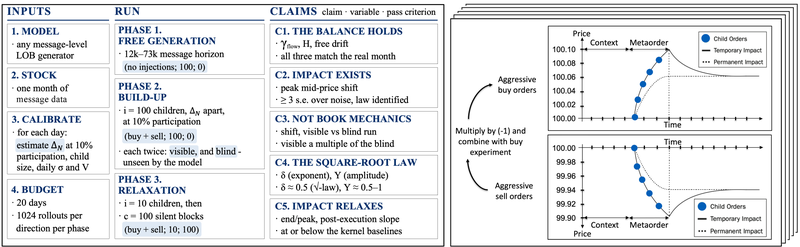
In a groundbreaking new study, George Nigmatulin and his colleagues from the University of Oxford have introduced the fLOB-Impact Benchmark, a vital new tool designed to evaluate the effectiveness of generative limit order book (LOB) models in the context of real-world trading impacts. This innovative framework addresses a critical issue in generative trading models: the accurate simulation of market impact caused by large orders.
The Significance of Market Impact
Accurate market simulation is fundamental for trading agents that operate within generative models. Traditional metrics have focused mainly on how closely a model's message streams resemble historical data, often ignoring how these models react to their own trades. The fLOB-Impact Benchmark recognizes that market impact can profoundly influence a trader’s actions. If a simulator misjudges this response, trading agents developed within it could end up employing strategies that fail in actual market conditions.
Understanding the Research Methodology
The research team injected execution-style metaorders into their generative models across five major NASDAQ stocks, measuring the subsequent market response. They employed estimators from existing empirical impact literature to validate their findings. The benchmark consists of three phases: free generation, metaorder injection, and post-execution evaluation, which collectively scrutinize the models' market impact dynamics.
Key Findings from the Benchmark
One of the most intriguing outcomes of the research is that all generative models displayed a market impact law characterized by exponents ranging from 0.63 to 1.21. This is notably above the traditional square-root law exponent of 0.5. However, the models did not exhibit the expected post-execution relaxation, which may stem from their relatively short context windows. The lack of relaxation signifies that while the models can generate realistic market impacts, they may not yet effectively simulate the dynamics of real market responses.
Implications for Future Trading Models
The implications of these findings are significant. The fLOB-Impact Benchmark not only sets a new standard for evaluating generative LOB models but also highlights necessary areas for improvement. Future models will need to enhance their ability to maintain longer memory to simulate the complex interactions and replenishments seen in actual markets. This could allow for more realistic trading agents that can adapt their strategies according to real-world conditions.
Conclusion and Open-Source Offering
The fLOB-Impact Benchmark represents a significant leap in the realm of financial modeling, providing a pathway towards more reliable and robust trading simulations. The authors have released the benchmark as an open-source tool to foster further innovation and validation within this critical area of finance.
This research not only underscores the importance of accurately modeling market impacts but also serves as a call to action for developers and researchers to refine their approaches to creating generative models that reflect the nuances of real-life trading environments.
For more details, you can access the research paper by George Nigmatulin and his colleagues here.
Authors: George Nigmatulin, Valentin Mohl, Sascha Frey, Kang Li, Aramis Marti-Shahandeh, Mihai Cucuringu, Anisoara Calinescu, Jakob Foerster, Stefan Zohren


