
Unmasking the Aftermath of a Viral Code Boom: Understanding the Hidden Challenges in Governance
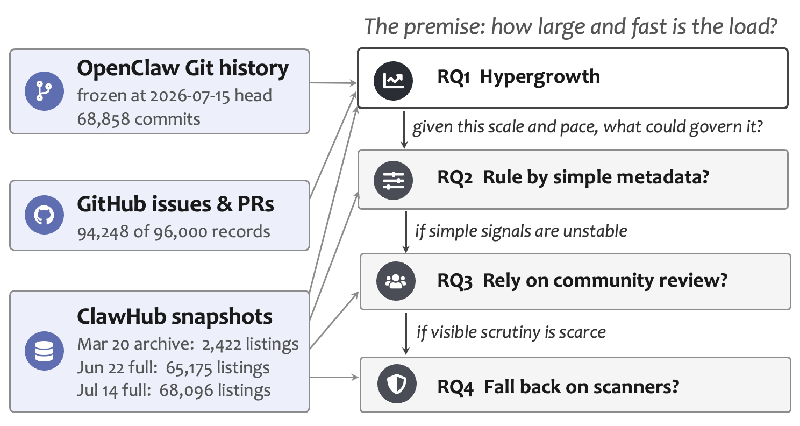
A recent empirical study from Monash University has unveiled the complex repercussions following the rapid expansion of the OpenClaw AI agent ecosystem. Researchers Yunpeng Xiong and Ting Zhang focused on the phenomenon of "agent skills," which are essentially instructions guiding AI agents to execute various tasks. Their findings highlight not just the spectacular growth of the skill registry but also significant challenges in its governance and security evaluation.
The Viral Rise of OpenClaw and Skill Registries
In early 2026, OpenClaw, an open-source AI agent, experienced a meteoric rise, nearly doubling its public skill registry listings from 33,399 to 65,175 within just over three months. This rapid growth had two major implications: it flooded the registry with new skills, while community feedback on these skills remained sparse. The study revealed that a staggering 77.86% of listings received no community reviews, raising questions about the true utility and safety of these skills.
Despite the explosive growth in the registry, download patterns showed that only a small fraction of skills received the bulk of engagement. The top 10% of skills accounted for a remarkable 46.93% of total downloads, emphasizing a significant disparity where only a few skills became the focal point for users.
The Challenges of Governance
Governance in such a fast-evolving ecosystem requires comprehensive strategies that exceed mere metadata tracking. The research highlighted that simple metrics, like download counts and user ratings, proved unreliable indicators of a skill's sustainability. Attempts to measure ongoing visibility or user interaction with skills showed that many skills created during the boom had little to no follow-up activity.
Xiong and Zhang characterized this phenomenon as a "reviewability gap": while almost all skills had some basic metadata visibility (like ownership), community feedback remained minimal. This lack of thorough review is alarming, particularly as 85.06% of skills exhibited signs of privileged access that could pose security risks.
Automated Scanners Under Scrutiny
To enhance safety, the registry employed automated security scanners to evaluate skills, but the study found inconsistencies among different scanners. They ranked by their ability to identify vulnerabilities, yet showed wide divergence in flagged outputs. The findings indicated that automated scans alone cannot guarantee the safety of skills, as agreement rates among scanners were low, with significant portions of flagged listings differing across tools.
The researchers advocate for more structured governance approaches that incorporate independent validation and robust measurement strategies to effectively manage large-scale registries.
Implications for Future Tech Governance
This research underscores a broader lesson about the need for transparency and capability in tech governance. As tech ecosystems like OpenClaw rapidly grow, so does the complexity of their management. Reliance on superficial metrics and automated tools without human oversight can lead to significant oversights, potentially fostering security vulnerabilities.
In conclusion, Xiong and Zhang's study highlights the urgent need for stronger governance frameworks that can adapt to technological advancements, ensuring safety while fostering innovation. Their call for better validation methods, comprehensive reviews, and clearer accountability measures may well serve as a blueprint for future tech ecosystems in navigating the intricate landscape of AI governance.




