
Unlocking Trust in AI: A Breakthrough in Selective Auditing Techniques
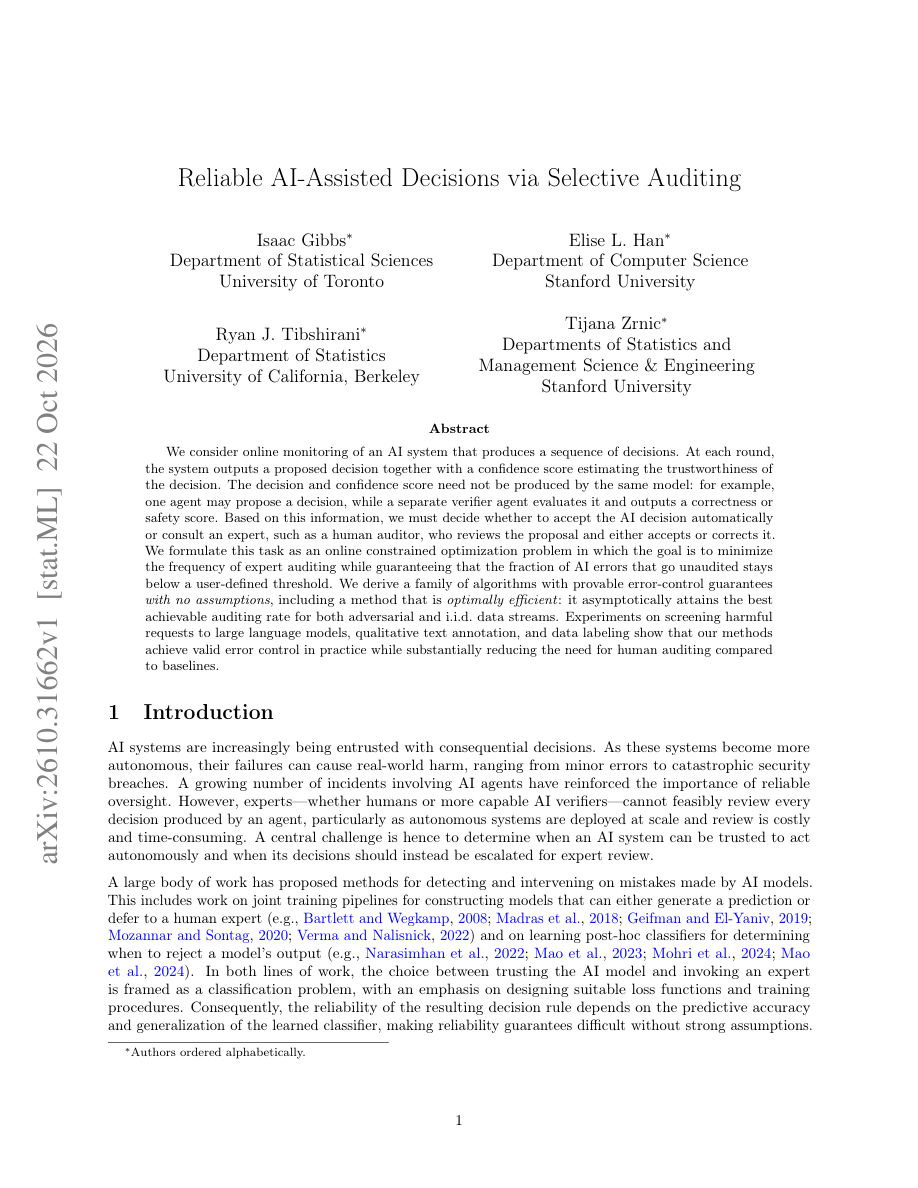
As artificial intelligence becomes an integral part of decision-making across various industries, ensuring the reliability of these systems is paramount. A recent research paper titled "Reliable AI-Assisted Decisions via Selective Auditing," authored by Isaac Gibbs, Elise L. Han, Ryan J. Tibshirani, and Tijana Zrnic, presents innovative methods aimed at minimizing the frequency of expert auditing while maintaining quality control over AI's decisions.
The Challenge of AI Autonomy
AI systems are increasingly relied upon for critical decisions, ranging from mundane tasks to sensitive operations like medical diagnoses or security protocols. However, errors in AI decision-making can lead to widespread adverse consequences. Currently, human experts are typically required to verify these decisions, which can be both costly and time-consuming, especially at the scale at which many organizations operate.
A Solution: Selective Auditing
The authors propose a novel approach called selective auditing. This method evaluates an AI's decision confidence before determining whether to accept the decision automatically or invoke a human auditor for verification. By treating the decision process as an online constrained optimization problem, the research aims to maximize decision efficiency while limiting human intervention to necessary cases. The goal is to keep the fraction of unaudited AI errors below a user-defined threshold.
Algorithmic Innovations
The paper details several algorithms that provide error-control guarantees without making strong assumptions about data distributions. Their approach combines computation techniques from online learning and adaptive decision-making processes. Importantly, they introduce algorithms that can achieve optimal efficiency rates, even when dealing with adversarial data streams—where the data might be intentionally misleading or challenging.
Real-World Applications and Experimentation
The researchers conducted extensive experiments to validate their methodologies. They applied their selective auditing techniques across various domains, including screening harmful requests to AI models, qualitative text annotation, and data labeling tasks. Results showed that their selective auditing methods not only maintained valid error control but also significantly reduced the need for human auditing compared to standard baseline methods.
Conclusion: A Step Towards Trustworthy AI
This research marks a significant advancement in the field of AI governance by creating frameworks that can assure reliability while promoting efficiency. As AI systems become more prevalent, implementing such auditing mechanisms is crucial for building public trust and ensuring safe operational practices. This innovative approach to auditing AI decisions could redefine how we perceive and interact with machine intelligence in everyday application.
By enabling AI systems to operate with less direct oversight while still ensuring that a safety net of human verification is available when necessary, we may be able to harness the full potential of AI technology responsibly.


