
Unlocking the Hidden Mechanism: How Neural Noise Enhances Our Ability to Predict Rare Events
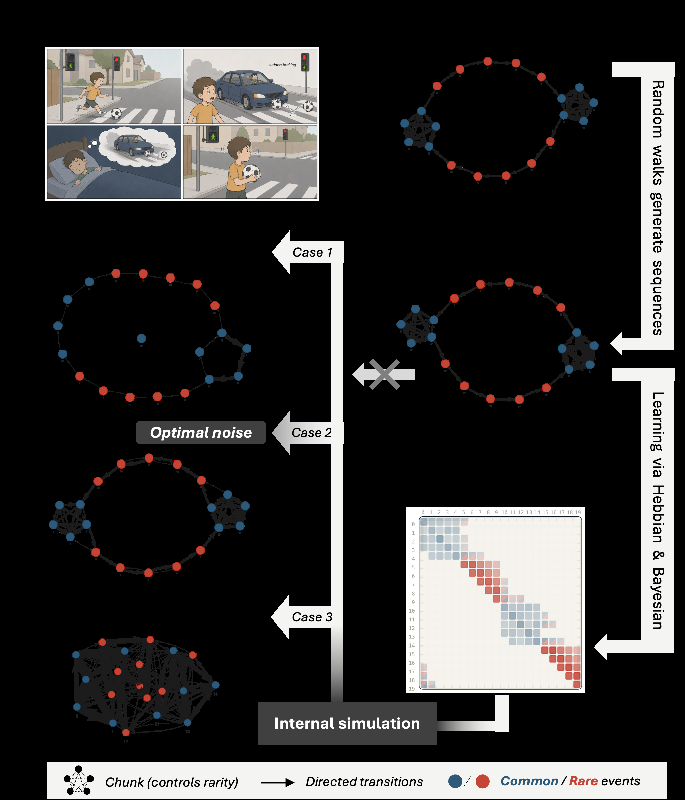
In a groundbreaking study from researchers at the International Research Center for Neurointelligence at The University of Tokyo and KTH Royal Institute of Technology, a remarkable discovery sheds light on the brain's ability to accurately predict rare events. The paper titled "Neural noise enables accurate internal simulation of rare events" dives deep into the complex dynamics of neural networks, revealing that moderate levels of neural noise play a critical role in refining our internal cognitive models. But what does this mean for our understanding of the brain’s prediction mechanisms?
The Challenge of Predicting Rare Events
When navigating daily life, humans constantly rely on their brains to create internal models of the world, inferring probabilities of future events based on past experiences. This predictability is often challenged by rare events—situations that, while infrequent, carry significant consequences. Traditional views suggest that the less frequently we encounter something, the less accurately we can predict its occurrence. However, this new research presents a novel perspective: that noise within neural activities may actually enhance our capacity to predict these rare occurrences.
How Neural Noise Makes a Difference
The researchers utilized a sophisticated model known as the Bayesian Confidence Propagation Neural Network (BCPNN), which was designed to simulate and analyze event sequences through a controlled environment. They discovered that introducing a moderate amount of noise into this network significantly improved its ability to produce accurate internal simulations of rare events. This noise acted as a counterbalance, preventing the deterministic pathways of neural activity from becoming overly rigid, which often led to misrepresentation of rarer events.
Insights into Internal Simulation and Predictive Processing
The findings suggest that what appears to be random variability in neural activity is, in fact, a beneficial mechanism that allows for more flexible and accurate internal simulations. Without this variability, the model struggled to represent rare events, leading to a distortion of predictions that could either overestimate or underestimate their occurrence. Strikingly, a controlled level of noise not only provided better accuracy in prediction but also made the cognitive process more robust against variations in neural parameters.
Implications for Future Research
This research carries far-reaching implications, especially for understanding neurological conditions such as Parkinson's disease, where the precision of internal models may become compromised. Enhanced understanding of how neural noise can aid or hinder prediction mechanisms could inform future therapeutic strategies aimed at mitigating cognitive deficits associated with such disorders.
In conclusion, this pivotal study challenges our conventional understanding of noise in neural computation. By highlighting the constructive role of neural noise in simulating rare events, it opens new avenues for exploration in neuroscience and cognitive psychology—suggesting that sometimes, a little noise might be just what we need to fine-tune our predictive abilities.
Authors: Heng Zhang, Pawel Herman, Zenas C. Chao




