Unlocking the Future of User Interfaces: How Affora Bridges Human and Agent Experiences
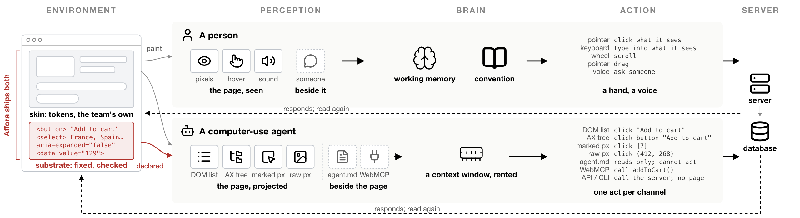
In an age where artificial agents are becoming increasingly prevalent in our digital lives, a critical question arises: how can we design software interfaces that cater to both humans and these computer-use agents? This challenge is met with the innovative design system known as Affora, developed by independent researcher Jin Gao. Affora strives to create user interfaces that visually appeal to humans while being fully accessible and operable for agents.
The Dual-reader Dilemma
As software evolves, it often operates in a world where both humans and agents interact with the same interface. The distinction lies in how they perceive and act on that interface. Humans rely on visual information, while agents interpret machine-readable data. Unfortunately, traditional design methods don't always account for this duality, often leaving tasks ambiguous for agents.
Introducing Affora: A Solution to Multi-reader Interfaces
Affora aims to address these challenges by providing a design system that facilitates a shared interface for both humans and agents. Taking inspiration from the concept of "affordance," which refers to the possibilities for action presented by an object, Affora ensures that necessary interactions are clear and comprehensible for both types of readers. This design system enables visual diversity while maintaining the underlying semantic structure of the interface, ensuring that it remains usable for agents.
Research Insights and Validation
The development of Affora is underpinned by rigorous research involving controlled studies. These studies highlight how various design choices impact agent performance. The results indicate that agents benefit significantly when the semantic structure of the interface is intact, regardless of visual changes made to enhance user experience.
For instance, in a study examining various design implementations, interfaces that used plain semantic HTML achieved a staggering 91% success rate for agent task completion, as opposed to lower rates for modern UI component libraries. This reinforces the idea that while a design may appear user-friendly for humans, it might still present challenges to agents if critical semantic information is not clearly represented.
Principles for Agent-friendly Design
From the vast research conducted, several design principles emerged that aim to enhance agent-friendliness:
- Make Structure Explicit: Ensure controls, choices, and states are clearly defined and accessible to the agent.
- Align Visuals and Machine-readability: Keep the machine-readable information consistent with what users visually perceive.
- Prioritize Discoverability: Task-critical information should be readily accessible without complex interaction steps.
- Maintain Semantic Continuity: Preserve essential meanings even as the visual design elements change.
Affora's Real-World Application and Impact
Affora is not just a theoretical concept; it has been implemented in real-world applications demonstrating its effectiveness. In workflow tests, using Affora has shown to reduce interaction costs by up to 40%, suggesting that not only does it enhance agent performance, but it also improves efficiency for human users as well.
This design approach facilitates smoother collaboration between humans and agents, allowing users to oversee complex workflows that agents handle swiftly but may be harder to follow step-by-step. The objective is to create an environment where human oversight is informed and effective, keeping both parties in sync.
The Road Ahead
As we look to the future, the implications of user interfaces that bridge the gap between humans and agents are profound. Affora represents a step towards embracing collaborative technologies, enabling seamless human-agent interaction in digital environments. Jin Gao’s groundbreaking work could redefine the way we interact with technology, ensuring that both users and agents thrive in a shared ecosystem.