
Unlocking the Future of Robotics: The Revolutionary CADRE Autoencoders for Real-Time Video Manipulation
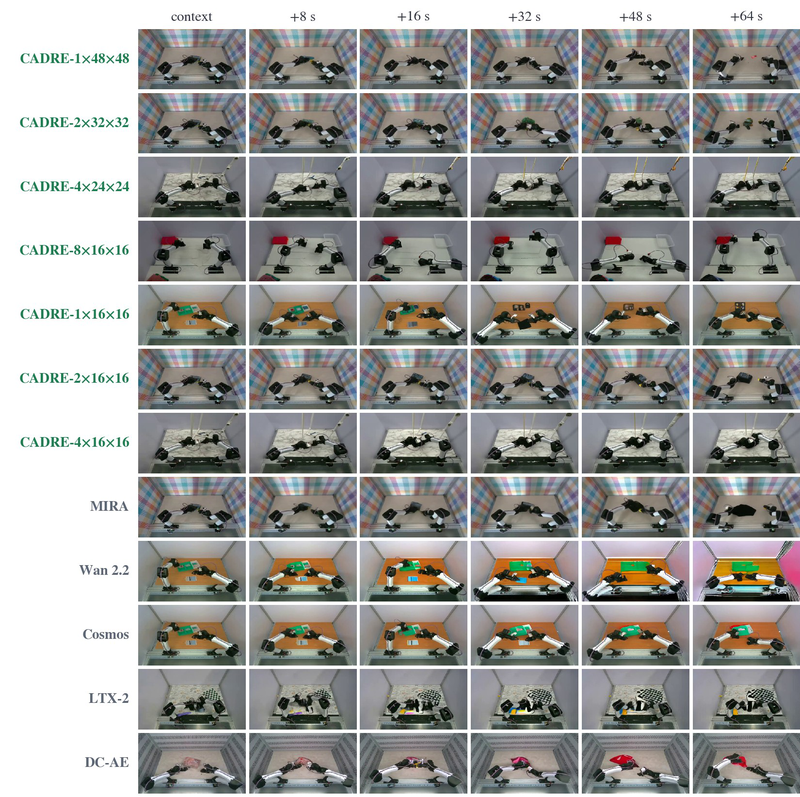
A groundbreaking study presented by Adrien Ramanana Rahary and colleagues has introduced CADRE, a new family of causal diffusion representation autoencoders designed for interactive world models. This innovative approach transforms how robots perceive and react to their environment in real-time, enhancing the efficiency and effectiveness of robotics across various applications.
The Problem with Current Video World Models
Video world models are essential for predicting future frames based on past experiences and agent actions. Traditionally, these models rely on autoencoders designed for text-to-video generators, which were not optimized for dynamic environments where quick decisions are crucial. One significant issue is latency: when robots act, any delay greater than 100 milliseconds can disrupt interaction, leading to potentially hazardous outcomes. The need for a new solution became evident as researchers sought to minimize this lag while maintaining high-quality visual outputs.
Introducing CADRE: A Solution for Optimal Compression
CADRE stands for Causal Diffusion Representation Autoencoders and features multiple spatio-temporal compression options. The team conducted experiments across two distinct domains—robot manipulation and navigation—to identify the most effective compression strategies. Notably, CADRE accommodates varying compression levels which enhance both the speed and visual fidelity of robotic responses.
Key Findings of the Research
1. **Balanced Compression Strategy**: The research found that manipulation tasks benefit more from temporal compression (when the camera is still), while navigation tasks should utilize spatial compression (when the camera moves). This insight could revolutionize how real-time simulations are devised, making robots more adept in fluid environments.
2. **High Responsiveness**: On average, CADRE maintains a frame generation speed of 20 frames per second with an action latency of under 230 milliseconds. This performance is crucial for applications in robotics, where real-time feedback is paramount.
3. **Diffusion Decoders Outperform Traditional Methods**: CADRE's diffusion decoder demonstrated sharper outputs compared to traditional perceptual regression techniques, especially in complex scenarios, further underscoring the potential for improved clarity in robotic tasks.
Applications and Future Potential
The implications of this research extend beyond mere efficiency. The CADRE models can be integrated into various robotic systems, enhancing their ability to navigate complex environments—such as autonomous vehicles, service robots, and interactive gaming NPCs. Moreover, the open-source nature of CADRE encourages further innovation and development in the robotics field, allowing researchers to refine these models and push the boundaries of what robots can achieve.
A Look Ahead
This study marks a significant step forward in addressing the challenges of real-time robotics. As this technology matures, we may soon witness robots that not only respond instantaneously but also understand and interpret their surroundings far more effectively than ever before. The potential applications are vast and could redefine human-robot interaction in the years to come.


