
Unlocking the Future of Risk Management: A Convex Variational Approach to Evaluating Worst-Case Scenarios
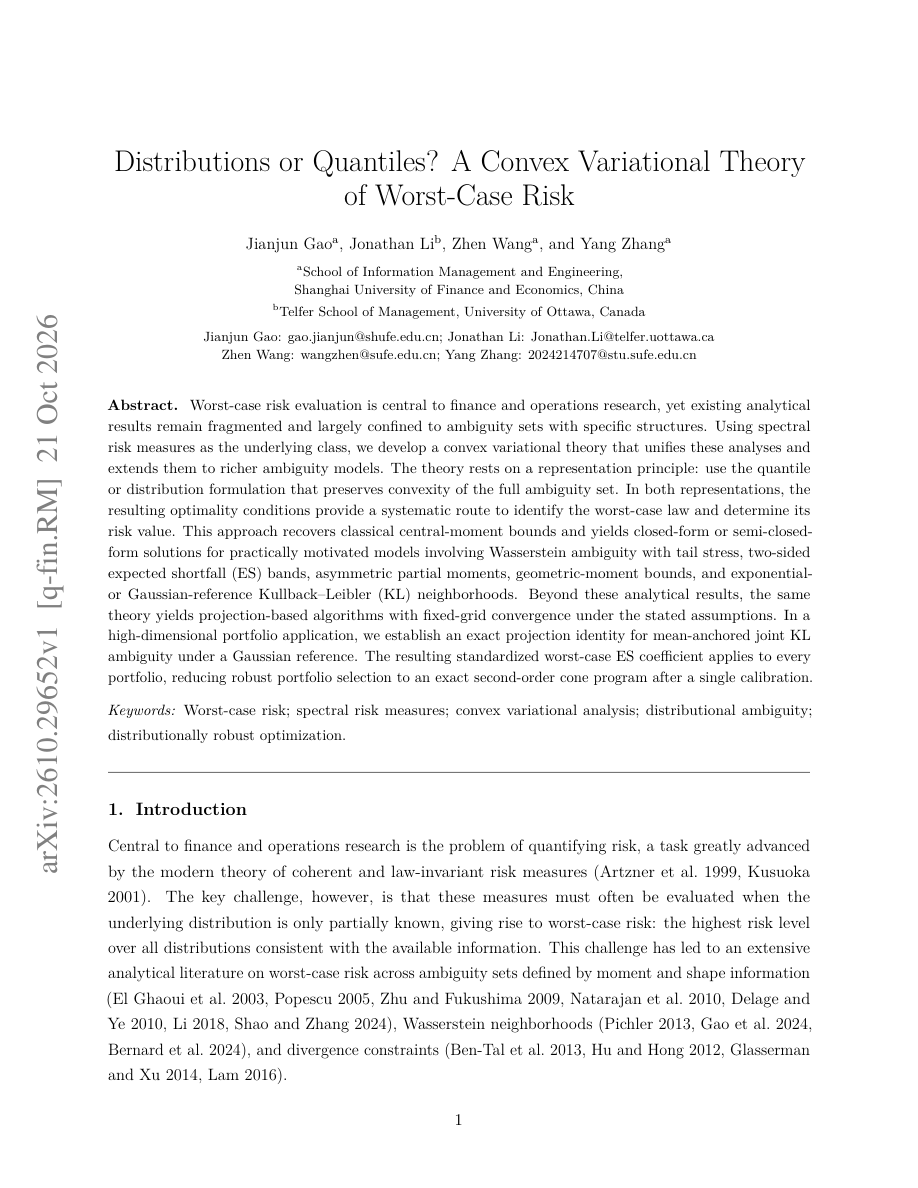
A recent research paper titled "Distributions or Quantiles? A Convex Variational Theory of Worst-Case Risk," authored by Jianjun Gao, Jonathan Li, Zhen Wang, and Yang Zhang, delves into the complexities of worst-case risk evaluation within finance and operations research. The study uncovers a robust framework for assessing risks when the underlying probability distributions are uncertain or partially known.
The Challenge of Risk Evaluation
In the realms of finance and operations, accurately quantifying risk is vital. Traditional methods often falter when the distribution of potential losses is ambiguous. The authors introduce a convex variational theory that amalgamates existing fragmented analyses, offering a systematic approach to worst-case risk evaluation across various risk models.
A Unified Framework
The researchers establish that using spectral risk measures can create a cohesive representation that greatly extends previous models tailored to specific ambiguity structures. This theory proposes the use of either quantile or distribution formulations, adhering to convexity principles, allowing for more flexible risk evaluations. Essentially, the theory provides methods to determine optimal conditions for identifying what the worst distribution of losses could look like and how risky it could be.
Key Findings and Applications
Among the significant contributions of this research is its ability to derive not only classical moment bounds but also to deliver closed-form or semi-closed-form solutions for various models, including those with Wasserstein ambiguity or expected shortfall demands. For instance, one particularly notable application is for mean-anchored joint Kullback–Leibler ambiguity in high-dimensional portfolio settings. The research demonstrates how this can transform a complex decision-making process into a manageable optimization problem.
Algorithmic Approaches
The paper also outlines the development of computational algorithms based on the convex variational framework, achieving fixed-grid convergence for the projection-based methods. These algorithms effectively tackle high-dimensional problems, thereby providing robust and efficient solutions to real-world financial challenges.
Conclusion: A Paradigm Shift in Risk Management
The findings from “Distributions or Quantiles?” present a transformative perspective on addressing worst-case risks. By integrating convex variational theory with practical applications in operations research, this research opens avenues for improved risk management strategies in the finance sector. As uncertainty continues to impact various sectors, this framework could allow professionals to make informed decisions backed by robust analytical methods.


