
Unlocking the Future of Clinical Research: How FL-Net Revolutionizes Federated Learning Across Borders
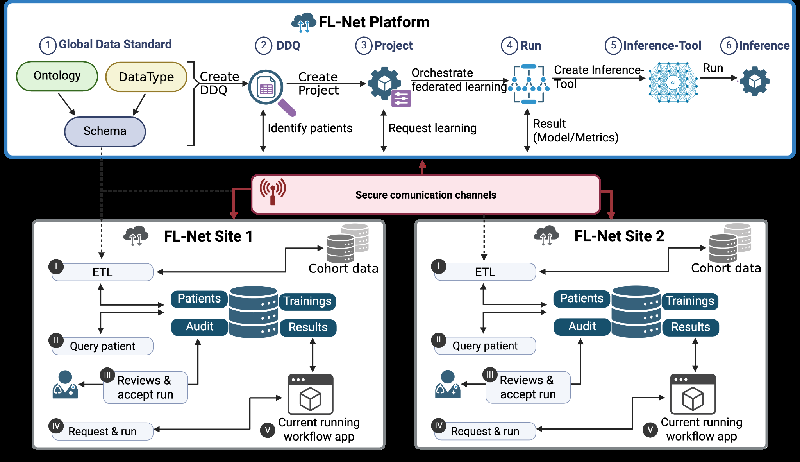
In an age where data privacy is paramount, the newly introduced FL-Net framework stands at the forefront of clinical research innovation. It allows multiple hospitals and institutions to collaborate on creating powerful machine learning models without ever sharing sensitive patient data. This revolutionary approach has the potential to improve patient outcomes on a massive scale by leveraging data across different healthcare systems while maintaining strict privacy protocols.
What is Federated Learning?
Federated learning (FL) is a method that enables the training of algorithms across decentralized data sources without the need to ever centralize or expose the data itself. Instead of pooling patient records, each participating site processes its data locally and sends only model updates (like adjustments based on learning) back to a central server. This minimizes risks and complies with stringent data protection regulations. However, until now, practical implementations of FL in real-world healthcare settings have faced significant challenges.
Meet FL-Net: A Comprehensive Solution
FL-Net is a groundbreaking federated clinical research framework designed to address the deficiencies of previous models. Developed by an extensive multi-center collaborative effort involving various European institutions, FL-Net comes equipped with five critical functionalities derived from existing research needs. These features include:
- Modular Data Harmonization: Ensures that data from diverse sources is structured and standardized effectively, allowing for seamless integration.
- Data Discovery: Enables researchers to conduct complex queries across various datasets to identify suitable data for training machine learning models.
- Disclosure Control: Implements strict privacy measures to ensure that sensitive patient information remains protected at all times.
- Federated Workflow Execution: Provides tools and workflows that can be reliably reused across multiple research projects, fostering reproducibility and consistency.
- Comprehensive Audit Trails: Tracks all processes and data interactions for transparency and accountability, essential for ethical research practices.
How FL-Net Works
FL-Net functions as a persistent, star-shaped network infrastructure, simplifying the collaboration process among participating sites. Each institution retains control of its local data while engaging in collaborative learning through the FL-Net Platform. Institutions only require a single outgoing authenticated connection to this central platform, reducing the complexity and administrative burden often associated with federated learning.
Once a researcher articulates a data discovery query (DDQ), participating sites can query their local datasets without compromising patient data privacy. Results are returned only as aggregated statistics, effectively shielding individual identities. Once enough suitable data is discovered and verified, a federated project can commence, utilizing the site-specific patient data to train models collaboratively.
Real-World Applications and Future Impact
FL-Net is not merely theoretical; it is actively being developed within significant EU projects like dAIbetes and Microb-AI-ome, which together plan to utilize data from over 800,000 patients across ten hospitals in nine countries. By bridging the gap between disparate healthcare systems, FL-Net offers a practical foundation for reproducible and privacy-preserving clinical research. It paves the way for future advancements in personalized medicine and patient care by democratizing access to high-quality data across institutional boundaries.
As federated learning continues to build momentum in practical applications, FL-Net provides an essential blueprint for educational institutions and healthcare providers globally to harness the power of data science for medical discovery while upholding the highest standards of data protection and patient privacy.




