
Unlocking the Future of AI Collaboration: Discover How Graph-Structured Optimization Revolutionizes Parallel Task Management
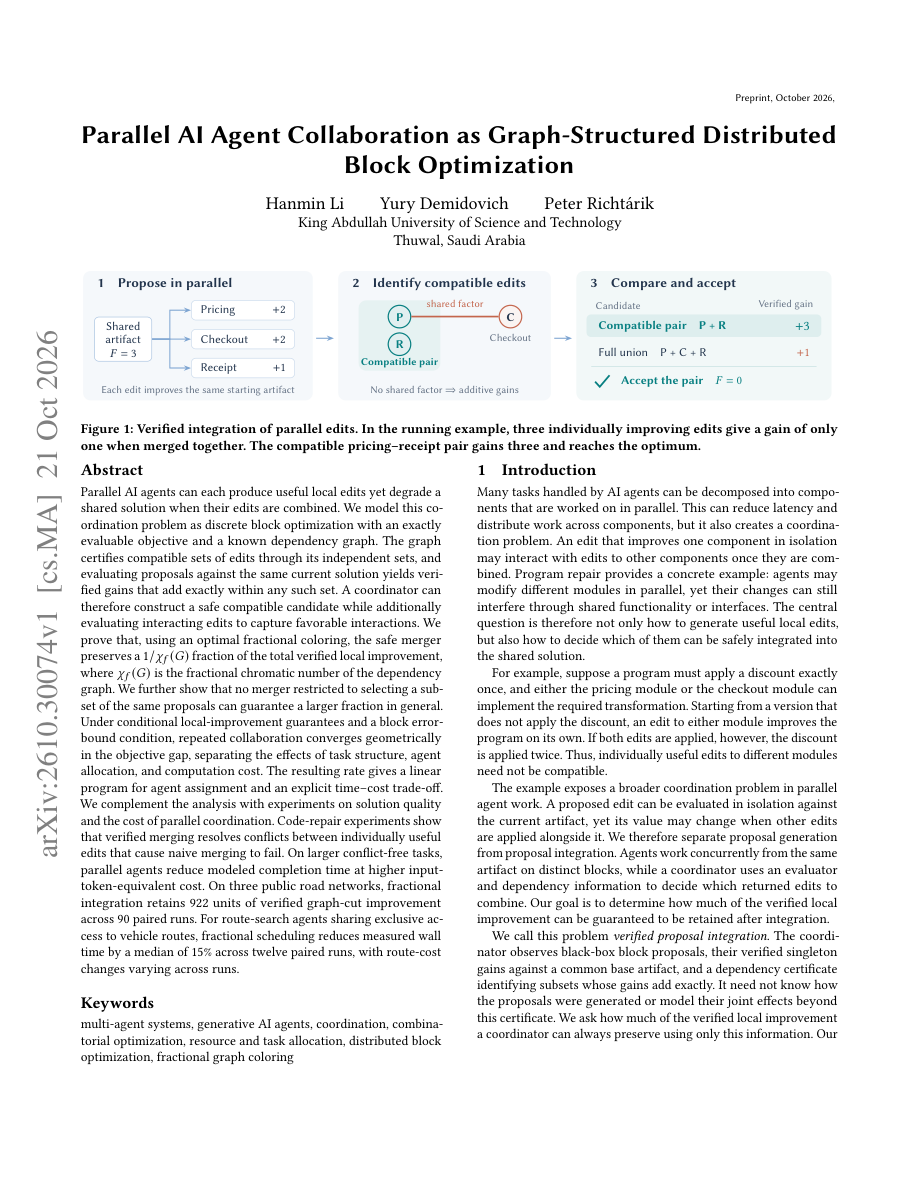
A groundbreaking research paper from Hanmin Li, Yury Demidovich, and Peter Richtárik presents a novel approach to optimizing the collaboration between parallel AI agents. This work, titled "Parallel AI Agent Collaboration as Graph-Structured Distributed Block Optimization," redefines how agents coordinate their edits to shared solutions. The research emphasizes the importance of understanding dependencies among task components to maximize the effectiveness of distributed AI efforts.
The Coordination Challenge
The main obstacle identified by the authors is the inherent risk of conflicts when multiple AI agents submit changes to a shared artifact. These conflicts arise because an improvement made by one agent might degrade the overall system performance when combined with edits from another agent. To tackle this issue, the paper proposes a model that treats these agent interactions as a combinatorial optimization problem, structured as a graph where nodes represent the edits and edges signify dependencies.
Introducing the Graph-Based Model
The authors develop a method to evaluate and integrate edits collaboratively via a dependency graph that helps to identify compatible edits and optimize their integration. Each agent proposes local improvements, which are assessed against the shared solution, and the dependency information ensures that merged proposals yield maximum verified gains without introducing conflicts.
In simpler terms, this model acts like a traffic manager for AI proposals, directing improvements to avoid overlaps that could cause system failures. By focusing on compatibility within a mathematical framework, the researchers can quantify how much of the individual improvements can be preserved after merging local edits into a global solution.
Key Findings and Implications
One of the pivotal findings of the research is that using fractional graph coloring—a method in mathematics related to assigning colors to graph vertices—can guarantee a specific retention factor of improvements during the merging process. Specifically, the paper proves that at least 1/χf(G) of the total verified improvement can be preserved using this method, where χf(G) denotes the fractional chromatic number of the dependency graph.
This result has significant implications for enhancing the efficiency of multi-agent systems in various fields, such as software development and resource allocation, as it provides a structured, mathematical basis for improving collaborative efforts among AI agents.
Experiments and Real-World Applications
The research includes experiments that showcase the effectiveness of their proposed model, particularly in code repair scenarios where individual edits made by agents were at risk of creating errors if merged improperly. The results confirm that the verified merging resolves conflicts that would otherwise cause naive merging strategies to fail. The application of these findings can lead to more robust AI tools capable of working together effectively, particularly in complex system designs like autonomous vehicles and distributed computing tasks.
Conclusion: A Significant Step Forward
In conclusion, this research represents a significant step forward in the coordination of AI agents, paving the way for more efficient and safer collaborative systems. The focus on graph-structured optimization provides a robust solution to long-standing challenges in AI task management, promising a future where intelligent systems can seamlessly work together to tackle complex problems.
Overall, the innovative approaches discussed in this paper could transform AI application in real-world scenarios, pushing the boundaries of what multi-agent systems are capable of achieving.
Authors: Hanmin Li, Yury Demidovich, Peter Richtárik
Institution: King Abdullah University of Science and Technology, Thuwal, Saudi Arabia


