
Unlocking the Complexity of American Put Options: A Deep Dive into Multi-Exercise Strategies
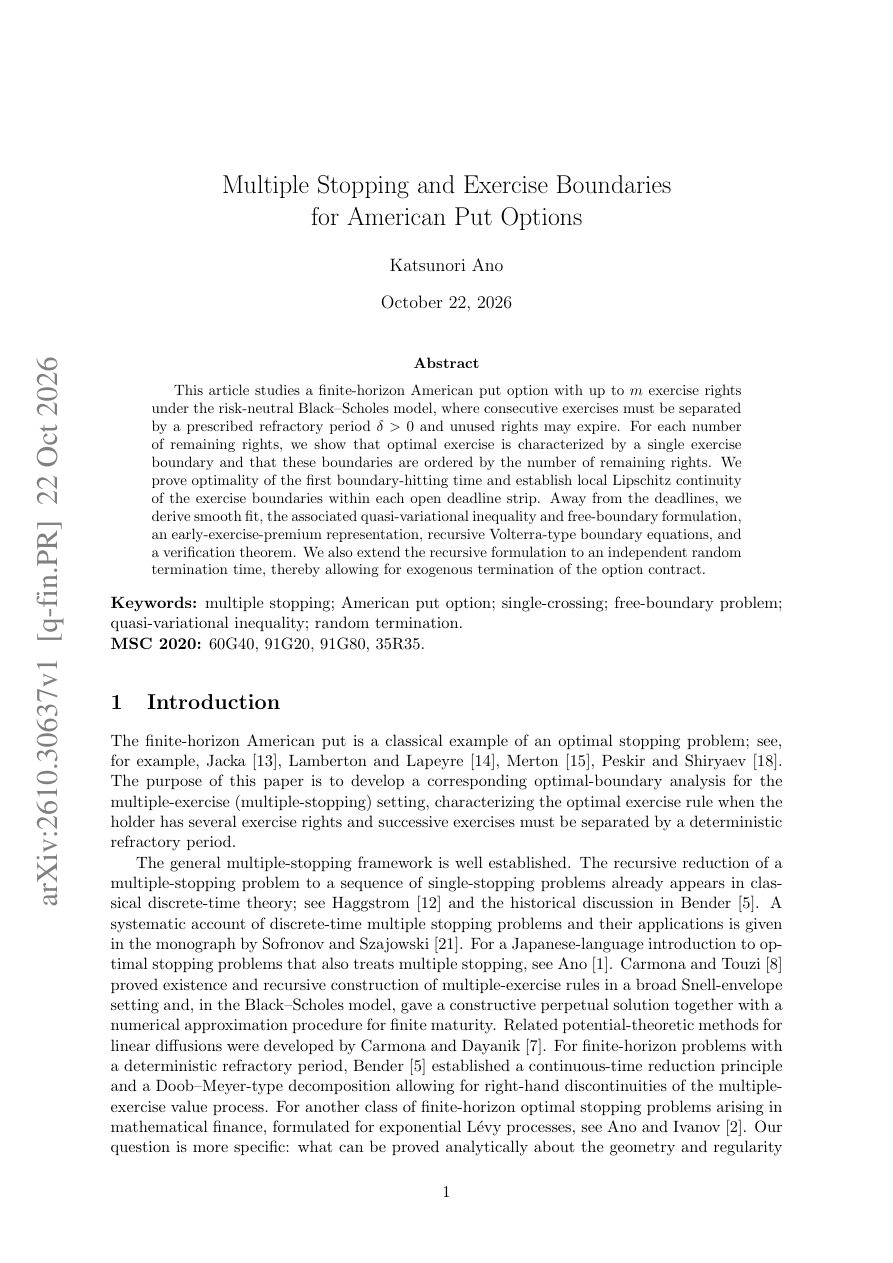
In a complex financial landscape, the control of American put options represents one of the most intriguing challenges for analysts and investors alike. A recent research paper by Katsunori Ano delves into this topic with remarkable insights into the optimal stopping strategies involving multiple exercise rights under the risk-neutral Black-Scholes model. The findings, set to be published in October 2026, are not only timely but promise to reshape how we think about option exercise boundaries.
Understanding American Put Options
American put options provide the holder the right to sell an underlying asset at a predetermined price before its expiration date. This flexibility can be particularly valuable in volatile markets, allowing investors to capitalize on price declines. However, determining the precise timing for exercising these options is crucial and complicated by various factors including market conditions and the number of remaining exercise rights.
A New Framework for Optimal Stopping
The crux of Ano's research is the introduction of a framework that accommodates multiple stopping points characterized by mandatory refractory periods—essentially a waiting period between successive exercises. This is significant because it allows for a more nuanced understanding of when to exercise options, with maximum benefits being captured strategically rather than at arbitrary intervals.
In this study, the author has identified that, irrespective of the number of remaining rights, the optimal exercise can effectively be delineated by a single exercise boundary in relation to time, enhancing clarity for traders who must navigate these complexities.
The Role of Exercise Boundaries
A key insight from the research is the establishment of analytical expressions for exercise boundaries in relation to multiple stopping rights. Ano’s approach reveals the dependency of these boundaries on the number of exercise rights remaining. The uniqueness of this arrangement is reflected in the discovery of a single-crossing property: as options approach their respective exercise boundaries, the value functions maintain a predictable pattern of behavior.
These boundaries are shown to evolve with time, making them crucial for understanding market dynamics, and providing a pathway to optimize the exercise decisions made by investors.
Practical Implications of the Findings
What does this mean for traders and financial analysts? With the proposed framework, practitioners can develop investment strategies that not only respond to real-time market conditions but also take into account the unique profile of multiple stopping options. The established equations and insights into setting exercise boundaries dramatically enhance the strategic toolkit available to investors, allowing them to potentially maximize returns.
As the financial markets continue to evolve, the insights provided by Ano’s research will likely lead to more refined hedging and speculative strategies for managing American put options. The dual pathways of recursive termination risk and the accompanying mathematical proofs lay essential groundwork for future studies in this critical area of finance.
Looking Ahead
The implications of Ano's findings extend beyond immediate investment strategies; they signal a move towards more sophisticated tools for modeling financial derivatives. As researchers and practitioners digest these revelations, we can expect a richer discourse surrounding optimal stopping problems, with new algorithms potentially emerging to make automated trading and risk management more effective.
In conclusion, Katsunori Ano's work on American put options stands to revolutionize how stakeholders navigate the complexities of option exercises, reflecting a significant advancement in the financial mathematics field.
Authors: Katsunori Ano


