Unlocking Sustainable Land Management: How Psychology Influences Ecosystem Outcomes
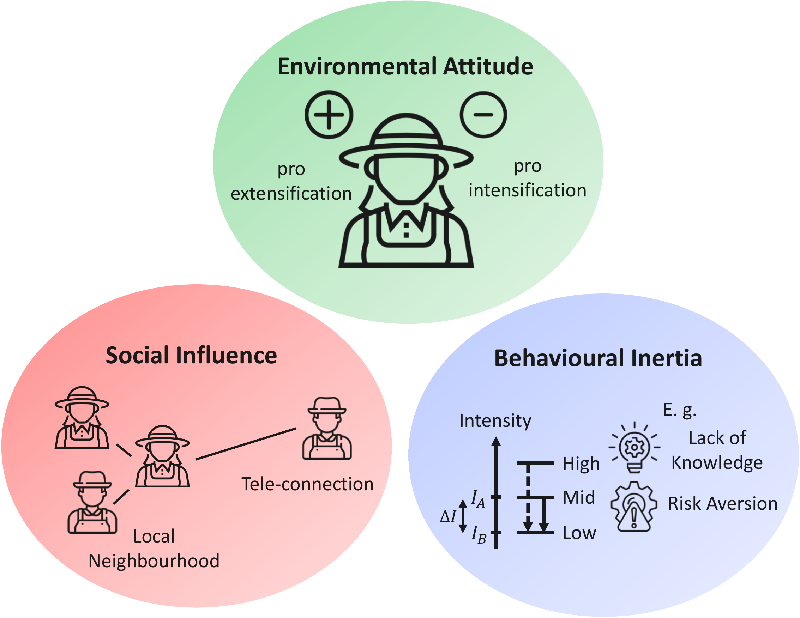
In a groundbreaking study by Ronja Hotz and colleagues, the intricate relationship between socio-psychological factors and land management practices is explored. Their research highlights that while economic and biophysical factors have traditionally dominated land use models, understanding the social and psychological drivers is essential for promoting sustainable land management.
The Role of Socio-Psychological Factors
The research addresses a significant gap in existing land use models, which often overlook the influence of behavioral factors like environmental attitudes and social norms. By utilizing the Theory of Planned Behavior, the researchers incorporated how these psychological components shape land managers' decisions regarding management intensity. Essentially, land managers' choices are not merely driven by profits or environmental conditions, but also by what they perceive others are doing and their personal beliefs about the environment.
Emerging Dynamics and Counter-Intuitive Outcomes
One of the most compelling findings of the study is the emergence of nonlinear feedback loops between these socio-psychological drivers and the landscape. For example, increasing adherence to social norms can lead to unexpected clustering of land management practices, creating more connected landscapes. This contradicts the traditional view that decisions are independent. Instead, decisions made by one land manager can significantly influence their peers, demonstrating that collective behavior can lead to substantial shifts in land use patterns.
Implications for Sustainable Development
The implications of this study are profound. Understanding how social influences and psychological attitudes shape land management practices opens new avenues for policy interventions aimed at sustainable agricultural practices. The findings suggest that simply providing economic incentives may not be sufficient; strategies that foster positive social norms surrounding sustainable practices are also crucial. This could include community programs that celebrate sustainable behaviors or the establishment of local groups that encourage best practices in land management.
Future Research Directions
This research sets the stage for further studies exploring how these socio-psychological factors can be integrated into broader land use models. It emphasizes the importance of examining the human dimension of land management and suggests that future policies should consider the social context in which land managers operate. By leveraging this knowledge, it's possible to create a more resilient and sustainable approach to land use that benefits ecosystems and communities alike.
In conclusion, the work of Hotz et al. brings to light the critical yet often overlooked psychological dimensions of land use. It encourages a rethinking of how policies are structured, aiming for a holistic approach that balances economic, environmental, and social factors for a sustainable future.
Authors: Ronja Hotz, Calum Brown, Yongchao Zeng, Thomas Schmitt, Mark Rounsevell

