
Unlocking Stability Secrets: How Stochastic Fluctuations Influence Chemical Reaction Networks
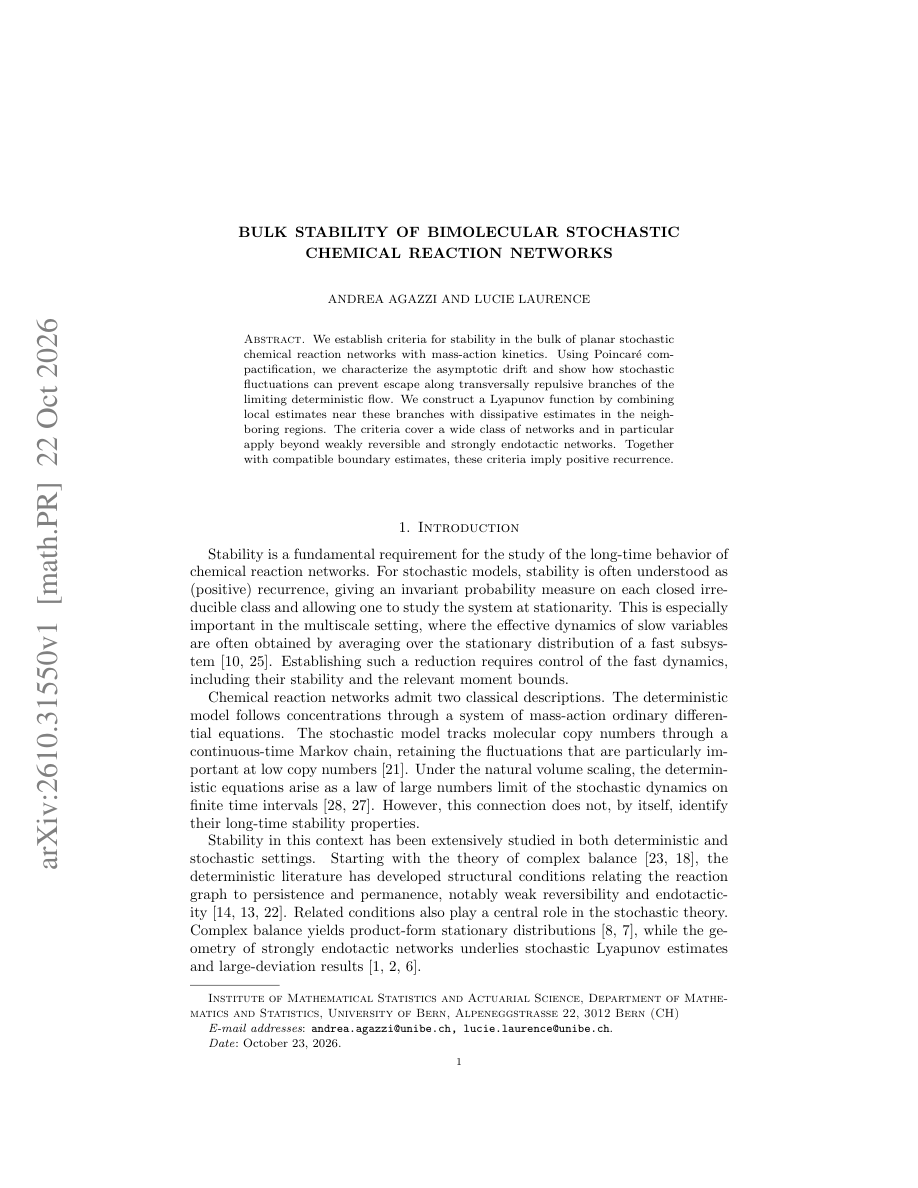
Stability in chemical reaction networks, especially those driven by stochastic processes, has always been a complex topic, especially regarding how they behave over time. In a recent paper by Andrea Agazzi and Lucie Laurence, groundbreaking insights have been unveiled regarding the bulk stability of bimolecular stochastic chemical reaction networks. The research reveals criteria for establishing stability amidst the unpredictable nature of these chemical reactions.
The Significance of Stability in Chemical Reactions
Understanding stability in chemical reactions is crucial, as it directly impacts predictions about how chemical substances will react over time. This is particularly vital in systems where the copy numbers of molecules are low, making stochastic effects more pronounced. The authors delve into the criteria that dictate the stability of these networks, which helps us understand their long-term behavior, especially in applications like drug development and environmental science.
Stochastic vs. Deterministic Models
The authors note that chemical reaction networks can be analyzed through both stochastic models, which account for randomness, and deterministic models, which simplify the system to average behaviors over time. While deterministic models can produce valid approximations under ideal conditions, they often fall short in accurately reflecting the complex dynamics at play in real-life scenarios, especially when small numbers of molecules are involved.
Key Insights from the Research
One of the significant breakthroughs in this research is the establishment of a framework using Poincaré compactification, a mathematical tool that allows for the exploration of the system's behavior as it approaches infinity. This analytical method provides a clearer understanding of how different paths of the chemical interactions can promote stability or lead to instability, governed by stochastic fluctuations.
The authors develop new energy functions based on local estimates to assess stability, which integrates both local and dissipative properties of the chemical network. Importantly, their findings suggest that noise, often perceived as a detrimental factor, can actually induce stabilization in specific scenarios. This counterintuitive discovery opens new avenues for control in chemical processes.
Applications and Further Implications
This research not only enhances our theoretical understanding of stochastic chemical reaction networks but also has practical implications across various fields, including pharmaceuticals, where precise control over chemical reactions is critical. By better predicting stability, researchers and practitioners can optimize reaction conditions to achieve desired outcomes more reliably.
Overall, Agazzi and Laurence's work challenges established notions while providing valuable insights into how stochastic elements play a pivotal role in determining the dynamics of chemical reaction networks. As we move forward, these findings will undoubtedly inspire further studies to explore the intricate balance between randomness and stability in chemical processes.
For a detailed exploration of the methodologies and mathematical frameworks utilized in this study, please refer to the comprehensive research paper.
Authors: {Andrea Agazzi, Lucie Laurence}


