
Unlocking Software Clarity: How HiddenLens Reveals the Hidden Assumptions in Requirements Engineering
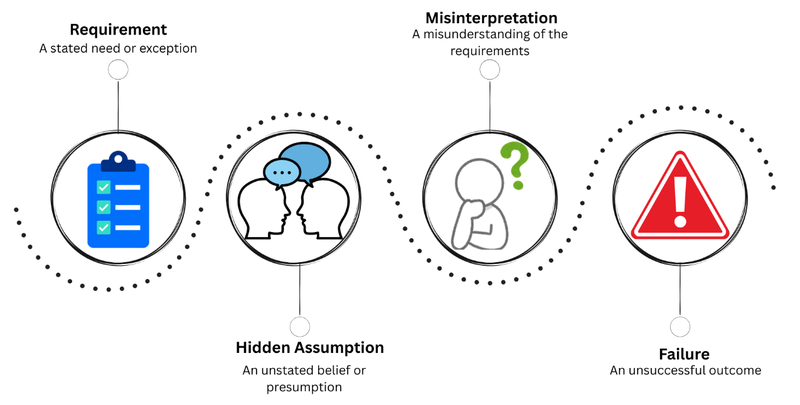
In the evolving landscape of software development, the importance of clear and precise requirements cannot be overstated. A recent research paper titled HiddenLens: A Multi-Layer LLM Framework for Detecting and Resolving Hidden Assumptions in Software Requirements unveils a groundbreaking approach to enhancing requirements engineering by addressing the often overlooked yet critical issue of hidden assumptions. This innovative framework could potentially transform how developers interact with requirement specifications.
The Problem with Traditional Requirements
Software requirements often fall short, failing to articulate underlying assumptions regarding performance, user expectations, and operating conditions. This leads to discrepancies between what stakeholders envision and what is actually implemented. Traditional methods focus on identifying ambiguities and inconsistencies but frequently miss the subtler, hidden assumptions that can derail projects if left unaddressed.
For instance, consider a requirement like “the system shall respond quickly.” Different team members might interpret “quickly” in varied ways, leading to confusion and misalignment in project execution. Without a structured approach to identify these unarticulated assumptions, software projects can face critical failures, resulting in significant costs and delays.
Introducing HiddenLens
The authors, Tanu Singh, Aashna Suman, and Vinod Patidar from UPES, have developed HiddenLens, a six-layer framework that utilizes advanced natural language processing techniques to uncover and clarify hidden assumptions in software requirements.
HiddenLens is designed to not just identify ambiguous terms but to provide a detailed analysis of the assumptions these terms mask. By employing a combination of BERT (Bidirectional Encoder Representations from Transformers) and large language models (LLMs), the framework systematically categorizes and resolves assumptions, enhancing the clarity and precision of requirements before development begins.
The Six Layers of HiddenLens
The framework operates through six distinct layers:
- Layer 1: Uses BERT's attention entropy to pinpoint ambiguous terms in requirements.
- Layer 2: Leverages LLMs with Chain-of-Thought (CoT) prompting to articulate the specific hidden assumptions each term conceals.
- Layer 3: Classifies detected assumptions into categories such as performance, security, scalability, and more.
- Layer 4: Suggests context-aware clarifications for analysts to consider.
- Layer 5: Facilitates a human-in-the-loop validation process where an analyst can confirm and refine assumptions.
- Layer 6: Finalizes by rewriting the original requirement to incorporate explicit clarifications.
A New Dataset for Hidden Assumptions
The research has also produced the HiddenLens Corpus (HLC), a first-of-its-kind dataset of annotated software requirements. It includes 312 requirements and 847 identified hidden assumptions, paving the way for more extensive research in this critical area. This dataset will serve as a valuable resource for future studies in requirements engineering, addressing a significant gap in the existing literature.
Empirical Success and Future Potential
Empirical evaluations demonstrated that HiddenLens significantly outperformed traditional keyword-based methods, achieving an impressive end-to-end F1 score of 0.79 for hidden assumption detection. This progress indicates that HiddenLens can immensely benefit analysts by revealing and resolving hidden assumptions early in the requirement gathering process, ultimately leading to more successful software outcomes.
As we move toward increasingly complex software systems, tools like HiddenLens may become indispensable, enabling developers to build systems that accurately reflect stakeholder expectations and requirements. The framework not only aims to improve clarity in requirements but also seeks to foster collaboration between technical and non-technical team members, bridging gaps in understanding and enhancing overall project success.


