
Unlocking Robotics: How AtomicRL Overcomes Long-Horizon Manipulation Challenges
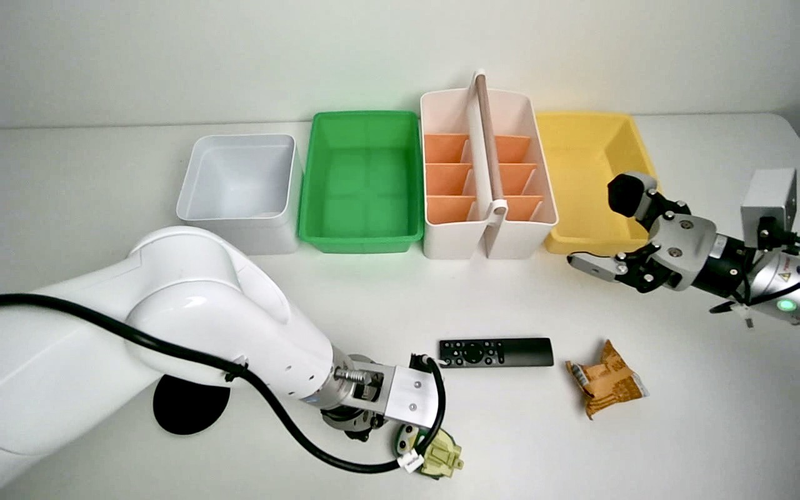
In groundbreaking research, a team led by Likui Zhang at Sun Yat-sen University has introduced a transformative approach to enhancing the capabilities of robotic manipulation through a framework called AtomicRL. This new method tackles the inherent complexities of long-horizon tasks in robotics, significantly improving how robots learn and execute elaborate manipulation skills.
The Challenge of Long-Horizon Tasks
Robots are increasingly being tasked with complex actions that require a series of smaller subtasks to be completed in succession. Traditional reinforcement learning (RL) methods often struggle with this type of learning due to issues like delayed reward feedback and the conflation of successes and failures across these subtasks. This is where AtomicRL comes into play, offering a unique solution to overcome these learning hurdles.
The Innovation Behind AtomicRL
AtomicRL employs a post-training framework built around atomic task structures, which allows for more reliable learning signals. One of its key innovations is Semantic-Aware Policy Optimization (SAPO), a technique that ensures that errors in one subtask do not skew the learning process associated with previous subtasks. This is accomplished by introducing a gating mechanism that adjusts the weight of feedback depending on whether the subtasks succeed or fail.
Another major component is the Bottleneck-Adaptive Target Exploration (BATE), which dynamically adjusts the exploration process based on the mastery levels of individual subtasks. This targeted approach prevents wasting time on subtasks that are already well-mastered while intensively focusing on problematic areas.
Real-World Applications and Performance Gains
AtomicRL has been shown to achieve significant performance improvements. In simulations, the research demonstrated success rates of nearly 99% with a new RL architecture, and in real-world tests, it improved task performance by an average of 21.3% across multiple robotic manipulation tasks. This level of performance showcases AtomicRL's capability not just in theoretical frameworks but in practical applications, making robots more efficient and reliable in various settings.
Transforming Robotic Learning
By integrating a Real2Sim2Real pipeline, AtomicRL connects simulation with real-world robot deployment, allowing for quicker and more efficient development of robotic skills. This pipeline optimizes the learning process by reducing costly trial-and-error methods traditionally associated with real-world robotic training. The research findings suggest a promising future for robotic manipulation, where intelligent robots can learn complex behaviors faster and more effectively.
Overall, AtomicRL represents a significant leap forward in the field of robotics, paving the way for advanced automation and interaction capabilities. The method’s focus on atomic tasks, along with innovative learning strategies, offers a new model for building smarter and more adaptable robots.


