
Unlocking Real-World Challenges: The Revolutionary SWE-DIVE Framework for Multi-Turn Coding Agent Evaluation
In the rapidly evolving landscape of artificial intelligence and software engineering, the need for robust evaluation frameworks for coding agents has never been greater. A recent study led by Lorenz Brehme from the University of Innsbruck, alongside collaborators from Microsoft and the same university, introduces a groundbreaking approach known as SWE-DIVE. This framework aims to bridge the gap between theoretical evaluations of coding agents and the complexities of real-world interactions.
Understanding the Problem with Traditional Evaluations
Traditionally, coding agents have been assessed using single, well-defined prompts pulled from platforms like GitHub. These evaluations often miss the mark when it comes to mimicking genuine interactions because real users don’t typically present problems in such structured formats. Instead, they engage in multi-turn dialogues where requirements evolve dynamically, leading to a more organic exploration of solutions.
The authors highlight that past benchmarks have often failed to simulate the nuanced back-and-forth that characterizes real-world scenarios. These limitations can lead to misleading assessments of a coding agent’s capabilities, as they are evaluated under conditions that don't accurately reflect actual user behavior.
Introducing SWE-DIVE
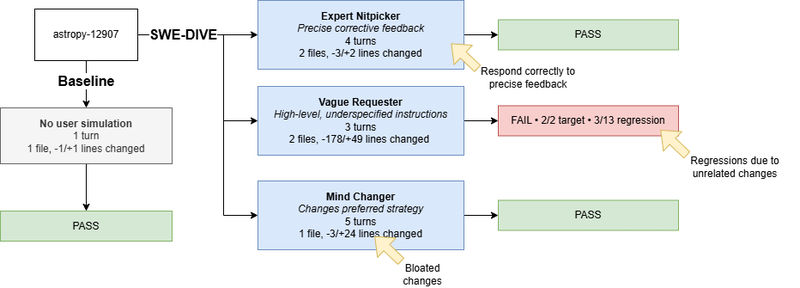
SWE-DIVE (Software Engineering Dynamic Interactive Validation and Evaluation) is a multi-turn interaction framework designed to evaluate coding agents more realistically. It introduces a user simulator powered by a large language model (LLM) that allows for varied user behaviors, emphasizing how agents can adapt to changing requirements. This innovative validation process not only assesses whether a coding agent can address a defined task but also how well it can navigate through evolving dialogues with users.
Key components include the user simulator, which mimics different behavioral patterns like an "Expert Nitpicker" and a "Vague Requester," and a conversation validator that checks whether the agent's outputs are promoting task success. By using SWE-DIVE, coding agents can now be evaluated on their ability to collaboratively refine problems and solutions progressively.
Dynamic Testing Environment
This new framework leverages a cooperative environment where the user simulator and coding agent interact iteratively. The user simulator is capable of modifying its requests based on the agent's responses, mimicking the real-time feedback and adjustment that occurs in actual software development workflows.
Moreover, SWE-DIVE utilizes the insights from previous research, demonstrating that users often don't just clarify existing requirements; they also introduce new tasks during interactions. This capability points to a more comprehensive evaluation metric that reflects the complexities of human-agent collaboration in software engineering.
Preliminary Findings and Implications
Initial results show that SWE-DIVE can effectively induce diverse behaviors in the coding agent, revealing how varying user requests impact the completion of tasks. In contrast to traditional frameworks, the study found that the interaction style significantly affected the agent's performance, uncovering hidden failure modes that would otherwise remain undetected.
With SWE-DIVE, the authors have laid the groundwork for the evaluation of coding agents that is more aligned with real-world applications. This framework promises to not only enhance understanding of agent capabilities but also potentially improve the quality of collaborative tools in software development.
A Call to Action for Future Research
The findings underscore the importance of incorporating dynamic, interactive frameworks in AI evaluations. As the fields of AI and software engineering continue to grow, adopting tools like SWE-DIVE could lead to significant advancements in how coding agents are developed, tested, and utilized in practical scenarios.
For those interested in the technical aspects, the source code and further results can be found in the researchers' GitHub repository, paving the way for future explorations and enhancements in coding agent evaluations.
In conclusion, while traditional evaluation methods have served a purpose, the need for more nuanced frameworks like SWE-DIVE is clear. As we continue to integrate AI into our development processes, creating systems that can better understand and adapt to user needs will be crucial for the advancement of software engineering.


