
Unlocking Quantum Computing Potentials: A Breakthrough in Adaptive Resource Allocation!
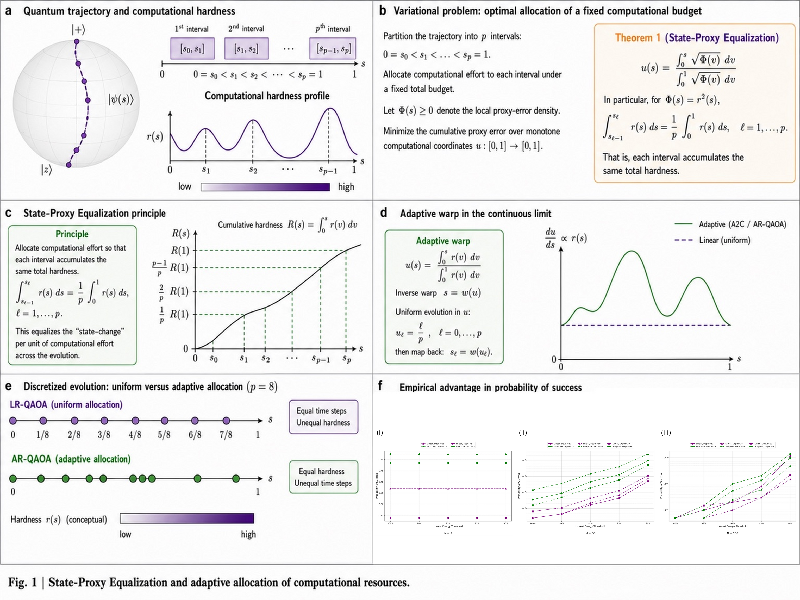
The world of quantum computing is constantly evolving, and with it comes the need for smarter software frameworks that can optimize computational resources. A recent research paper titled Beyond Hardware: Adaptive Algorithmic Control by State-Proxy Equalization offers a transformative approach to quantum computation that could revolutionize how we allocate finite resources during calculations.
What is Adaptive Algorithmic Control (A2C)?
A2C is a new software paradigm introduced by authors Jianlong Lu, Hongrui Zhang, Vishal Sharathchandra Bajpe, Thorsten Koch, and Ying Chen. Instead of relying solely on hardware improvements—like better processors or longer coherence times—this framework emphasizes the importance of resource allocation throughout quantum computations. This means that how we distribute our computational effort can significantly impact performance, regardless of the hardware's capabilities.
The State-Proxy Equalization Theorem
At the heart of A2C is the State-Proxy Equalization theorem, which suggests that optimal resource allocation depends not on the physical time spent on tasks but on the cumulative “computational hardness” experienced during a quantum algorithm's execution. In simpler terms, different parts of a quantum calculation may require varying levels of precision, and A2C helps identify where that precision is most valuable.
This insight allows researchers and engineers to concentrate their computational resources where they are needed most, enhancing efficiency and improving results in quantum optimization tasks.
Impressive Results in Quantum Optimization
The team validated A2C's effectiveness across various quantum optimization problems involving up to 156 qubits. They demonstrated remarkable improvements in low-energy sampling probabilities, seeing increases between 22% to over 100,000% compared to traditional methods. This level of enhancement shows that merely investing in hardware is not enough; a strategic approach to resource utilization is equally crucial.
Why This Matters
This research signifies a paradigm shift in the quantum computing landscape, where the interplay between hardware and algorithmic strategies can lead to more efficient computations. As quantum devices continue to advance, being thoughtful about how we deploy these resources could unlock practical benefits for real-world applications—ranging from materials science to cryptography.
By establishing A2C as a complementary pathway alongside hardware development, researchers lay the groundwork for future innovations that could make quantum computing more accessible and practical for diverse fields.
Final Thoughts
The findings from this study challenge conventional wisdom about quantum computing and open the door to new methodologies in computational resource management. As we venture further into the quantum era, Adaptive Algorithmic Control could be integral to realizing the full potential of quantum technologies.
In conclusion, the research suggests it’s not just about having the best quantum computer—it's about knowing how to make it work smarter, where the integration of software and hardware can yield extraordinary results.
Authors: Jianlong Lu, Hongrui Zhang, Vishal Sharathchandra Bajpe, Thorsten Koch, Ying Chen




