
Unlocking Lightning-Fast Query Responses: How fStructured Memory is Revolutionizing Edge Language Models
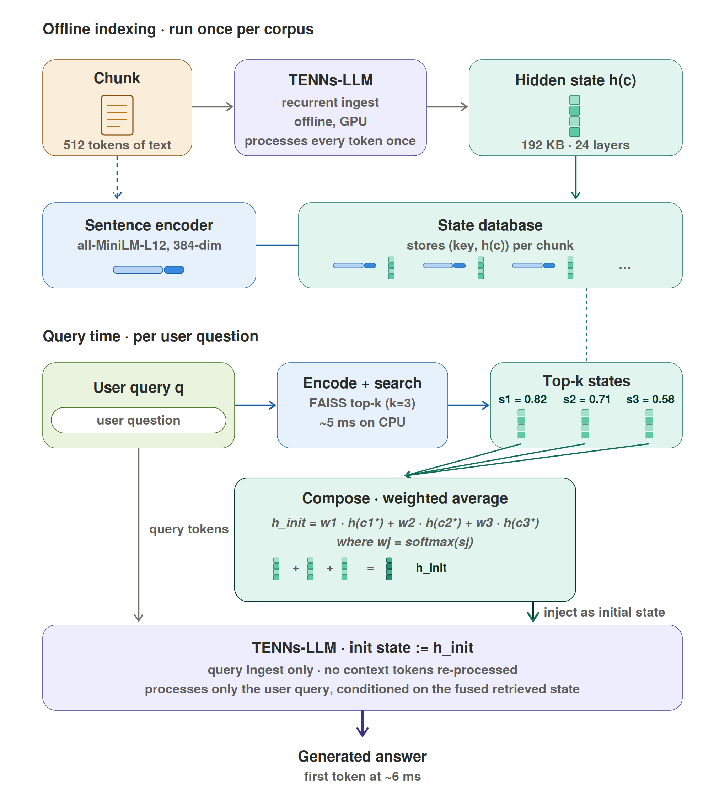
In the world of artificial intelligence and machine learning, speed is often as crucial as accuracy. A groundbreaking research paper titled "fStructured Memory for Edge Language Models: Persistent Context and Corpus Retrieval via O(1) SSM State Injection" introduces a revolutionary technique that significantly reduces the latency involved in query processing. This approach combines innovative retrieval mechanisms with structured memory to pave the way for faster, more efficient language models capable of functioning well on edge devices.
The Challenge of Traditional Models
Traditional language models, particularly those built on the popular Transformer architecture, face substantial limitations. The key-value (KV) cache they rely on grows linearly as they process more context, which can result in significant delays. For instance, generating responses often involves a lengthy context-ingestion phase that can take upwards of 27 seconds. This time-consuming process is unsuitable for real-time applications, especially where user experience hinges on swift responses.
Introducing PRECOG: A Game-Changer
The authors present PRECOG (Pre-Computed Context Injection), a novel retrieval mechanism that transforms this process. PRECOG allows for a remarkable reduction in the context-ingestion cost, decreasing the time required to retrieve context from O(Lcontext) to O(1) - meaning it takes the same amount of time regardless of the amount of context needed. This is achieved by pre-encoding document corpora into fixed-size summaries, which can then be injected into the system at query time, entirely bypassing traditional in-context ingestion methods.
How It Works: Structured Memory Consolidation
PRECOG’s design leverages the unique properties of State-Space Models (SSMs), which compress prior context into a position-agnostic, fixed-size state. This allows for quick injection of previously retrieved context directly into the model. To complement this, the research also describes Structured Memory Consolidation (SMC), which organizes and retains memory to provide persistent context over time. This hierarchical memory system not only retains short-term states but consolidates them into a long-term memory framework, enhancing the capacity to pull relevant information on demand.
Impressive Results on Real-World Tasks
The effectiveness of PRECOG was tested using the TENNs-LLM, a 1.2B-parameter language model. The results were staggering; while traditional models would take around 27 seconds for context ingestion, PRECOG allowed for response times of less than 6 milliseconds—a speedup of approximately 4500 times. This makes applications of such models considerably more feasible in interactive settings, such as customer service chatbots or real-time translation services.
The Future is Exciting
As this research illustrates, the integration of PRECOG and SMC into edge language models holds the potential to not only enhance speed but also improve the overall efficiency of information retrieval in AI applications. In a tech landscape where milliseconds matter, advancements such as these are ushering in a new era of real-time, interactive machine learning capabilities that could revolutionize user experiences across a multitude of sectors.
With the combined advantages of structured memory and rapid context retrieval, the prospects for more responsive AI systems look brighter than ever.
Authors: Anusha Madan Gopal, Aras Pirbadian, Kristofor D. Carlson, M Anthony Lewis, Jonathan Tapson




