
Unlocking Large Code Repositories: Discover How Code Comprehensor Revolutionizes Code Understanding
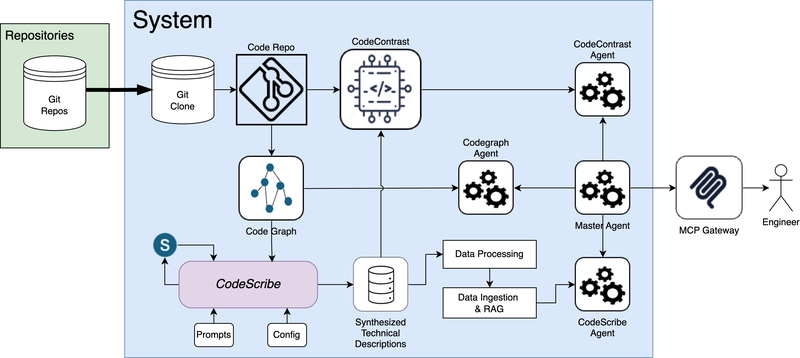
In the rapidly evolving landscape of software engineering, understanding vast and complex codebases poses a significant challenge. Enter Code Comprehensor, an innovative framework developed by a team from Ericsson R&D, aimed at enhancing code comprehension for large software repositories. This groundbreaking approach combines advanced techniques in code documentation and retrieval to improve efficiency in software development processes.
The Challenge of Code Complexity
As software repositories grow, they often become intricate maze-like structures that are not only hard to navigate but also hinder onboarding and maintenance efforts. Senior developers usually bear the burden of understanding these complexities, which introduces inefficiencies in the Software Development Life Cycle (SDLC). Additionally, while Large Language Models (LLMs) have emerged as powerful tools capable of understanding and explaining code, they face their own set of barriers when tasked with navigating extensive codebases.
Introducing the Code Comprehensor Framework
Code Comprehensor stands out by integrating several core components to tackle these challenges:
- CodeGraph: This call graph is generated through static analysis, providing a structured representation of the code's interdependencies.
- CodeScribe: A documentation engine that produces hierarchical documentation across repository call graphs, making complex structures easier to understand.
- CodeContrast: Utilizing a CLIP-style dual-encoder model, it enables fast and semantically precise retrieval of relevant code-context neighborhoods.
The combination of these components allows for a more nuanced understanding of code, facilitating not just static documentation but dynamic code interaction.
Breaking Down the Technology
At its core, Code Comprehensor operates as an end-to-end system. CodeGraph captures the relationships between different methods and files. CodeScribe produces documentation that mirrors the organization of the code itself, enhancing readability and navigation. CodeContrast employs advanced contrastive learning methods to align text and code, facilitating accurate search and retrieval.
Empirical Evidence of Impact
Test evaluations conducted on two repositories—OpenCV and a proprietary large-scale repository—demonstrated that CodeScribe-derived supervision significantly enhances the accuracy of text-to-code retrieval tasks. Impressively, the results showed improvements of top-1 accuracy by 9% or more over baseline approaches, indicating that higher-quality documentation translates directly into better retrieval performance.
The Future of Code Understanding
Looking ahead, the team behind Code Comprehensor envisions expanding its capabilities by integrating multimodal features such as structural graphs and visual diagrams. These extensions promise to capture relationships and workflows that are challenging to articulate solely through text. As software repositories will continue to grow and evolve, tools like Code Comprehensor will be crucial for maintaining understanding and facilitating seamless navigation.
In conclusion, Code Comprehensor is set to redefine how developers interact with complex code repositories, paving the way for more efficient and effective software development practices. With its innovative approach to documentation and retrieval, this framework represents a significant leap forward in addressing the perennial challenges posed by large-scale software projects.
Authors: Sujoy Roychowdhury, Joseph H. R. Isaac, Jiangning Gao, Martin Klitte, Diarmuid Corcoran


