
Unlocking Image-Text Synergy: Discover How ERCLIP Enhances Long-Caption Retrieval with Minimal Data
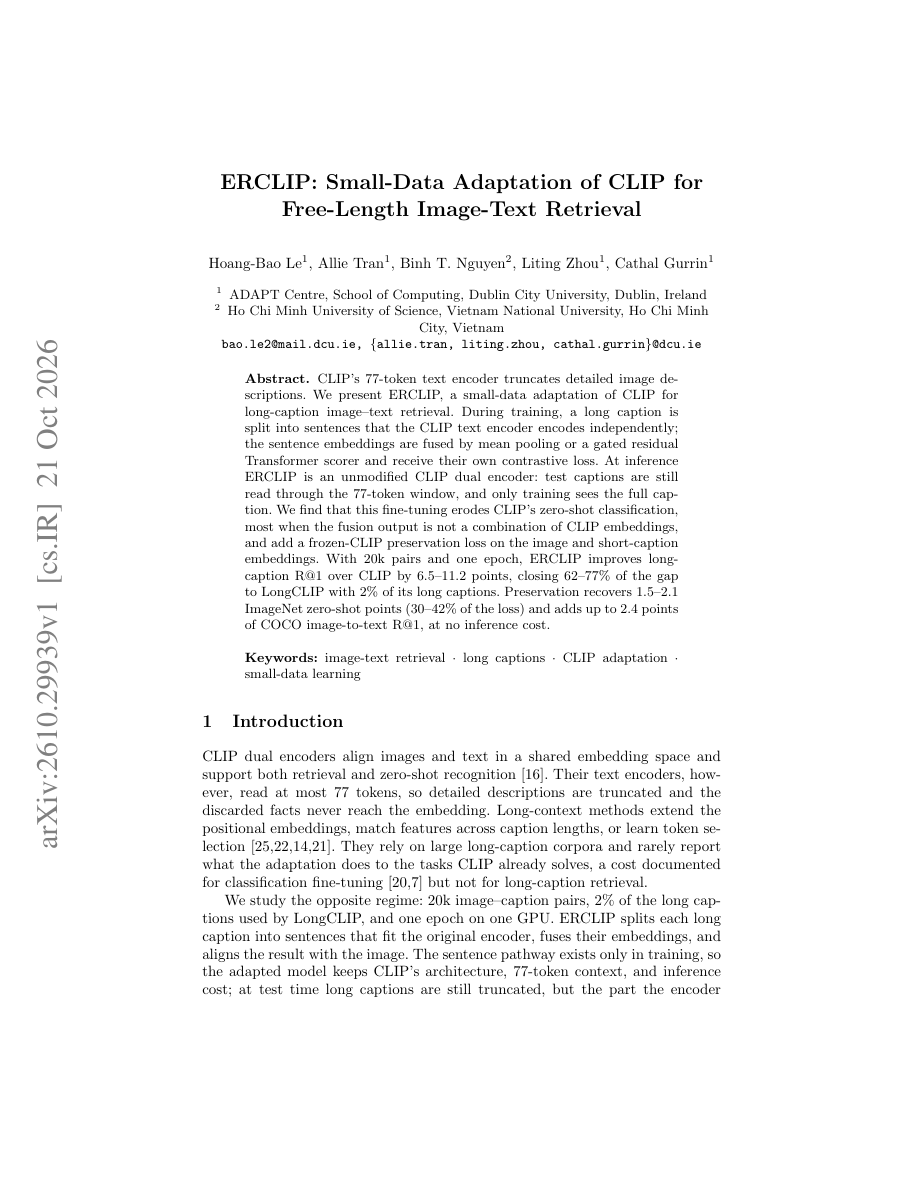
In the rapidly evolving world of artificial intelligence, a transformative new model called ERCLIP has emerged, designed to overcome a significant limitation in existing image-text retrieval systems. Conducted by researchers from Dublin City University and Ho Chi Minh University, this study reveals how ERCLIP adapts the popular CLIP (Contrastive Language-Image Pretraining) framework for effective long-caption retrieval, using a remarkably small data set.
The Challenge of Long Captions
Most current models, like CLIP, are limited to processing only a brief segment of text—specifically, 77 tokens. This truncation often results in the loss of nuanced information present in longer image descriptions, hindering their performance in image retrieval tasks. ERCLIP addresses this issue by employing a unique training method: it splits long captions into manageable sentences, each encoded separately, and cleverly fuses these embeddings to enhance the alignment with corresponding images.
Innovative Approach with Small Data
ERCLIP distinguishes itself by achieving impressive results using only 20,000 image-caption pairs—roughly 2% of the data typically required for similar tasks. Through a single epoch of training, the model not only enhances long-caption retrieval capabilities but also maintains the underlying architecture and efficiency of CLIP, thereby ensuring that it continues to perform well in zero-shot classification tasks.
The researchers found that by strategically fusing sentence embeddings—using methods such as mean pooling and a gated residual Transformer—the model demonstrates a significant improvement in long-caption recall rates of up to 11.2 points compared to the original CLIP.
Results and Implications
The findings from ERCLIP indicate that it successfully narrows the performance gap when compared to larger models like LongCLIP, achieving 62% to 77% of its performance improvement despite using substantially less data. Not only does ERCLIP show better alignment during inference—when long captions are truncated—it also recovers a portion of the lost capabilities in zero-shot image classification tasks.
This reveals critical insights: with smart adaptations and minimal data, models can maintain functionality across various tasks, highlighting a potential avenue for future research in low-data scenarios.
The Road Ahead
As ERCLIP continues to pave the way for improved image-text interactions, its implementation could enable more widespread applicability across specialized domains that commonly experience data scarcity. By ensuring that sophisticated models remain effective even with limited datasets, this research suggests transformative implications for AI applications in fields such as medical imaging, automated content creation, and personalized user experiences.
For anyone interested in the intersections of AI, language processing, and computer vision, ERCLIP represents a compelling leap forward in our capabilities to understand and retrieve complex visual and textual information.
Authors: Hoang-Bao Le, Allie Tran, Binh T. Nguyen, Liting Zhou, Cathal Gurrin


