
Unlocking Image Security: The Dynamic S-Box Revolution with CNN Technology
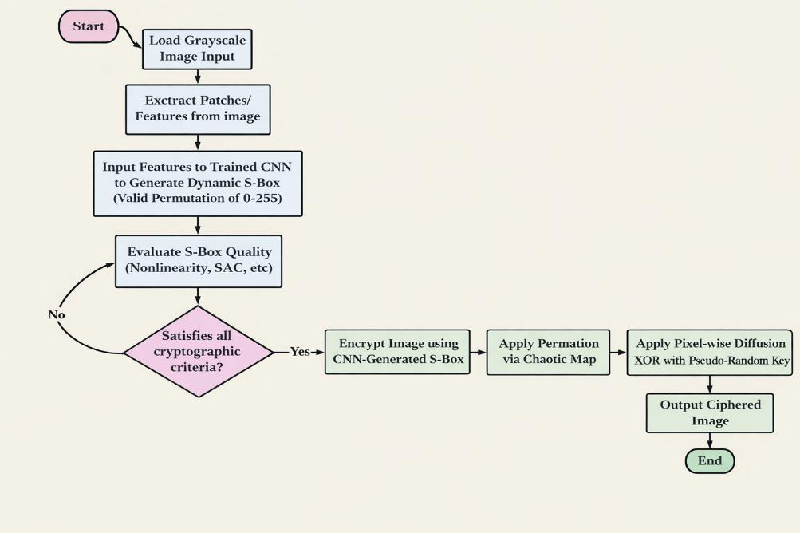
In an era where digital images are prevalent but vulnerable to various attacks, a recent research paper has introduced a groundbreaking technique for image encryption that could redefine how we protect our digital assets. By combining Convolutional Neural Networks (CNNs) with classical cryptographic principles, researchers have crafted a dynamic approach to image encryption that promises enhanced security and adaptability.
The Importance of Image Security
As the transmission of images over insecure media increases, traditional encryption methods are increasingly inadequate. Images have unique properties—high data volume and strong data correlation—that make conventional text-based encryption algorithms ineffective. This has fueled a demand for encryption methods tailored specifically to the intricacies of image data.
Introducing Dynamic S-Boxes
At the core of this new encryption algorithm is the concept of dynamic S-Boxes. Unlike traditional fixed S-Boxes which are prone to attacks due to their rigidity, dynamic S-Boxes adapt based on the characteristics of the image being encrypted. This adaptability increases non-linearity and confusion, making the system significantly more resistant to linear and differential attacks.
How It Works: CNN at the Helm
The proposed approach harnesses CNNs to learn and generate optimal S-Boxes based on the input image's features. Here’s a simplified breakdown of the process:
- Training the CNN: The researchers train the CNN using a dataset of grayscale image patches to understand local patterns and relationships.
- S-Box Generation: The CNN produces unique S-Boxes for each image, enhancing encryption complexity and robustness.
- Confidentiality Boost: Each input results in a distinct S-Box, complicating known-plaintext or differential attacks.
Performance and Security Assessment
The new method has been rigorously tested against standard benchmarks. Metrics such as entropy, pixel correlation, and histogram uniformity indicate that this novel algorithm excels in security. For instance, entropy values approached the ideal of 8, demonstrating high unpredictability in pixel distributions. Further, the algorithm showcased impressive performance metrics, completing encryption in less than 50 milliseconds even for high-resolution images.
Real-World Applications
This encryption method is designed for practical use, offering a solution that balances high security with computational efficiency. As more sectors rely on images—ranging from personal photography to sensitive medical records—this advancement could be instrumental in safeguarding visual data against unauthorized access or attacks.
The Future of Image Encryption
The implications of this research extend beyond just image security; they point to a future where adaptive and intelligent encryption systems, driven by artificial intelligence, become the standard. By continuing to explore the potential of CNNs in cryptography, we stand to revolutionize the way we protect our digital information.
With this innovative approach, the researchers aren't just promising a new encryption technique—they're setting the stage for a paradigm shift in data security. The combination of machine learning and cryptography opens up exciting possibilities for creating more secure, efficient, and adaptable encryption systems.
For further details, the paper was authored by Mohammad, Maryam Mahdi Alhusseini, Fadhil Abbas Fadhil, Ans Ibrahim Mahameed, and Nikolai Safiullin, and can be accessed for more comprehensive insights on their findings and methodology.




