
Unlocking GPU Virtualization: A Game-Changer for Performance Analysis in Virtual Environments
As the demand for high-performance computing grows, so does the need to optimize data processing capabilities. A recent study by Adel Belkhiri and Michel Dagenais sheds light on the crucial role of Graphics Processing Units (GPUs) in enhancing application performance and addresses the challenges posed by GPU virtualization in complex environments. This groundbreaking research proposes a novel performance analysis tool specifically designed for GPU-accelerated virtual machines, providing much-needed insights into resource usage and potential bottlenecks.
The Parallel Power of GPUs
Historically, GPUs were primarily used for rendering graphics. However, advancements have transformed them into powerful computing units capable of performing complex calculations across various fields, including deep learning and financial analytics. With the rise of GPU virtualization, multiple virtual machines (VMs) can share the physical GPU's resources, promising greater efficiency and reduced operational costs in data centers. Yet, despite these advantages, performance analysis tools for virtual GPUs (vGPUs) have been lacking, which often leads to underutilized hardware and inefficient resource management.
Challenges in Analyzing vGPU Performance
One of the primary obstacles in analyzing vGPU performance is the architectural diversity among different GPU brands. Moreover, many performance monitoring tools do not support vGPUs, leading developers and practitioners to struggle with diagnosing issues and optimizing performance. This situation highlights the necessity for a robust solution that can provide deep insights into the performance dynamics of vGPU systems.
A New Tool for a New Era
Belkhiri and Dagenais's proposed framework utilizes advanced performance analysis techniques by implementing a tracing method that captures detailed runtime data. This innovative approach allows for effective diagnostics and the identification of performance bottlenecks without intrusively installing software within the VMs themselves. By focusing on the host operating system's kernel space, their tool maintains VM privacy while gathering crucial performance metrics with minimal overhead.
Key Innovations of the Framework
The study introduces several enhancements that make this performance analysis framework stand out:
- Minimal Overhead: The new framework averages around just 1.01% overhead during tracing operations, which is significantly lower than traditional profiling methods.
- Synchronized Graphical Views: The tool provides various synchronized graphical representations to assist practitioners in understanding the intricate operations of GPU virtualization technologies like Intel's GVT-g.
- Unified State Model: A robust data model organizes performance data efficiently, ensuring that crucial metrics are easily accessible for further analysis.
Real-World Applications
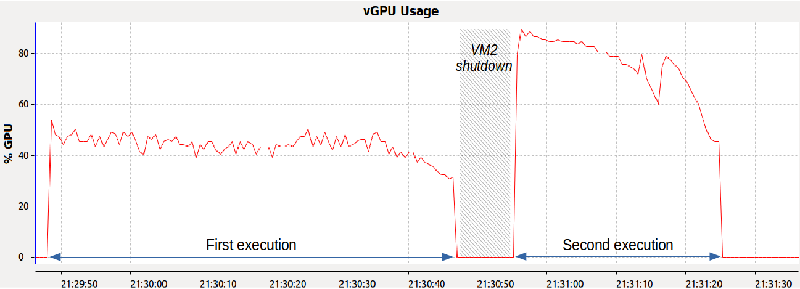
The framework is designed to not merely function in theory but to demonstrate practical utility across different scenarios. In experiments, the authors examined the internal mechanics of the GVT-g scheduler and its impact on performance in shared vGPU environments. Findings showed how competing VMs could significantly affect each other's performance based on operational loads, leading to proposed enhancements in scheduling algorithms to improve efficiency.
Future Implications
This research presents a significant step towards realizing the full potential of GPU virtualization. As cloud computing and virtualization continue to evolve, the findings and tools developed here could redefine how we understand and optimize resource allocation in data centers. Belkhiri and Dagenais also plan to expand their framework to include other popular GPU virtualization technologies like NVIDIA Grid, making this work increasingly relevant as industry demand for advanced computational resources surges.
In conclusion, their work bridges a critical gap in GPU performance analysis and sets the stage for more efficient utilization of virtualized computing resources. The implications of this study could thus be transformative for industries reliant on high-performance computing.
Authors: Adel Belkhiri, Michel Dagenais




