
Unlocking Financial Gains: The Secret to Smarter Portfolio Management with News Timing
In the fast-paced world of finance, timely information can be the difference between a lucrative investment and a missed opportunity. A recent study by Bolin Song from Cornell University and Surui Xiang from the United Nations delves into this concept, exploring how old financial news influences investment decisions. Their research highlights the delicate balance between utilizing aging signals and filtering out outdated information to optimize portfolio returns.
The Dilemma of Old News
Financial news can significantly sway investment strategies, with new information potentially leading to swift market adjustments. Yet, as news ages, its urgency diminishes. The critical question addressed by the authors is: Should investors retain signals from old news or filter them out before making portfolio decisions?
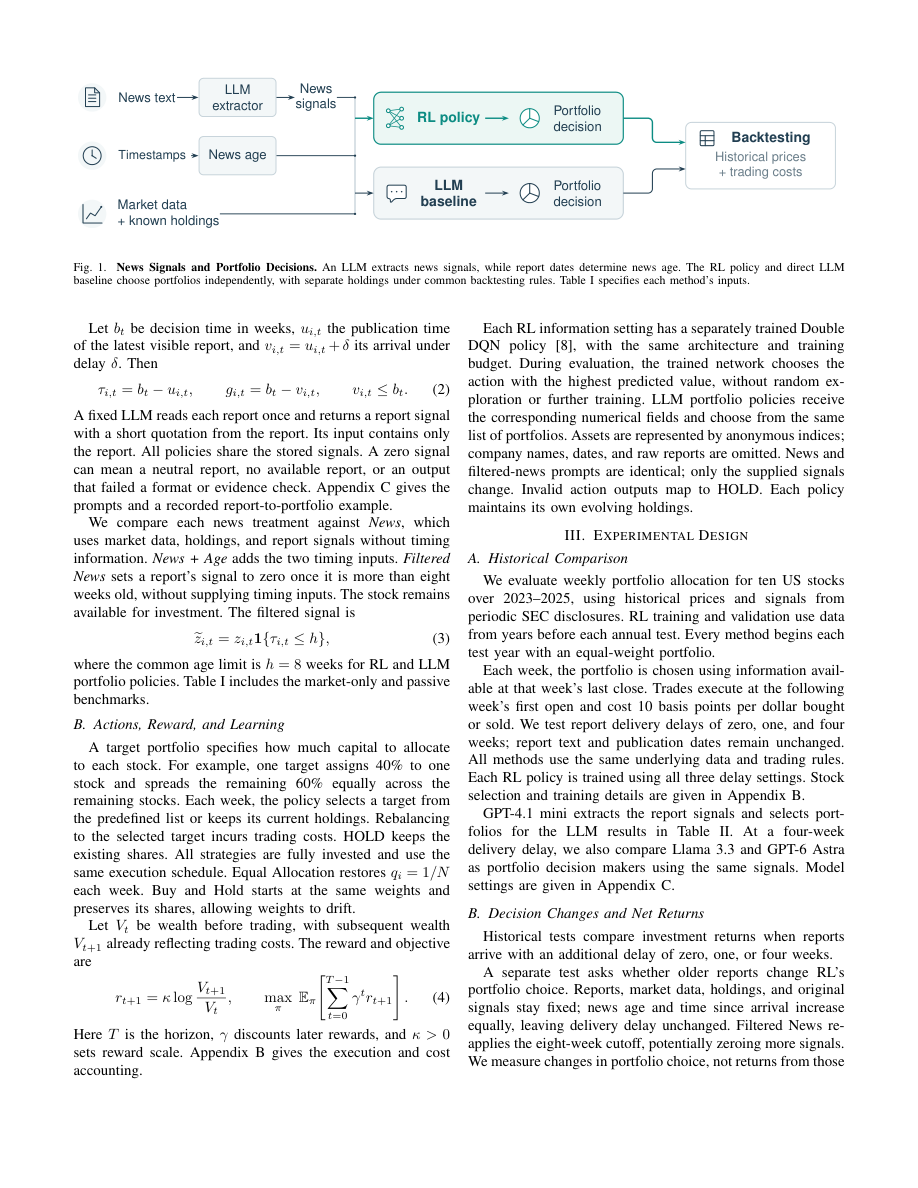
By leveraging a fixed large language model (LLM) to extract insights from public SEC disclosures, the research explores two main strategies. One method keeps older signals, providing a portfolio policy with essential timing information, while the other filters these outdated pieces before selection. The impact of these strategies on investment outcomes was examined through reinforcement learning (RL) policies and LLMs, with results suggesting that filtering old news could yield better returns.
Key Findings: The Power of News Filtering
The study's findings are compelling. When experimenting with strategies over a historical timeline from 2023 to 2025, the authors found that portfolios using filtered news signals achieved an impressive average annualized return of 18.43% when news delivery was delayed by four weeks. This method outperformed various RL strategies that retained older signals.
The results underscore the importance of distinguishing between old and new information. By filtering out signals from reports older than eight weeks, the researchers demonstrated that investors could achieve more stable and favorable returns, particularly in dynamic markets.
Implications for Investors
The implications of this research are profound for both individual and institutional investors. The findings suggest that portfolio managers should not merely soak in every piece of news but critically assess the relevance of information based on its age. The study indicates that a simple age filter could significantly enhance investment performance, leading to smarter decision-making in portfolio management.
As financial markets continue to evolve with technology, the integration of models like LLMs combined with strategic filtering of news will play an increasingly vital role in maximizing returns and managing risk effectively. Investors who adapt to these insights may set themselves apart in tomorrow's financial landscape.
In conclusion, this study serves as a reminder that in the world of finance, not all news is created equal. As the adage goes, "Time is money," and understanding the timing of financial information can indeed make a substantial difference in investment outcomes.
Authors: Bolin Song (Cornell University), Surui Xiang (United Nations)


