
Unlocking Complex Networks: How Graphlets Offer a Fresh Perspective on Structural Fingerprinting
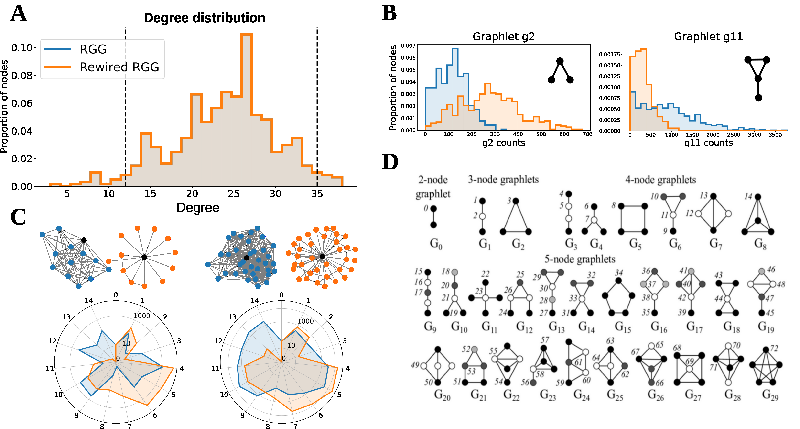
Understanding complex networks, from social connections to neuronal pathways, can be a daunting task. A recent study introduces a revolutionary approach by leveraging graphlets as structural fingerprints, providing a more detailed insight into these intricate systems. This innovative framework, presented by a group of researchers, promises to enhance our ability to characterize and differentiate between various networks.
What are Graphlets?
Graphlets are small, connected subgraphs that act as fundamental building blocks for complex networks. They can be thought of as miniature network structures that preserve local connectivity patterns, allowing researchers to explore intricate relationships within the broader context of a network. The study focuses on graphlets of size up to five, leading to 73 unique types that serve as 'fingerprints' for networks.
Why Use Graphlets for Structural Fingerprinting?
Traditional methods of analyzing networks often rely on specific graph-theoretical measures (GTM) that provide insight into either local or global characteristics but may overlook subtler structural details. The introduction of graphlet fingerprints allows for a more nuanced understanding by capturing local connectivity patterns in a systematic manner. This enriched perspective is particularly valuable in fields like neuroscience, where the organization of brain networks is critical for understanding function and dysfunction.
Applying Graphlets to Brain Connectivity
The researchers applied their framework to empirical data from resting-state functional connectomes, particularly focusing on differentiating between healthy individuals and those with schizophrenia. Their findings suggest that graphlets offer significant sensitivity to localized perturbations in brain connectivity, which is especially relevant given that schizophrenia may manifest through such isolated changes.
Key Findings and Implications
Throughout their experiments, the team noted that graphlet-based fingerprints often outperformed traditional GTMs, especially when subtle network differences were present. However, in certain classifications, such as schizophrenia versus healthy controls, the graphlet framework proved to be comparably effective but limited in comparison to adjacency-based features. This speaks to the need for a hybrid approach that utilizes both local pattern descriptors and adjacency measures for a more robust analysis.
Ultimately, the introduction of graphlets as comprehensive and flexible structural fingerprints marks a vital step forward in network analysis. By providing a method to capture and analyze local-to-mesoscale structure, researchers can better understand not only the typical configurations of networks but also how deviations from these norms may signal conditions like schizophrenia. As datasets grow in size and complexity, tools like graphlets will be essential in deciphering the intricate web of connections that define our world.
As this research unfolds, it opens the door to a new era of computational neuroscience and complex network analysis, enhancing our understanding of various domains, from brain connectivity to social network dynamics.
Authors: Anna Pidnebesna, David Hartman, Aneta Pokorná, Daniel Trlifaj, Jaroslav Hlinka




