
Unlocking Clarity: The Breakthrough CAMGen Framework for Smarter Commit Messages
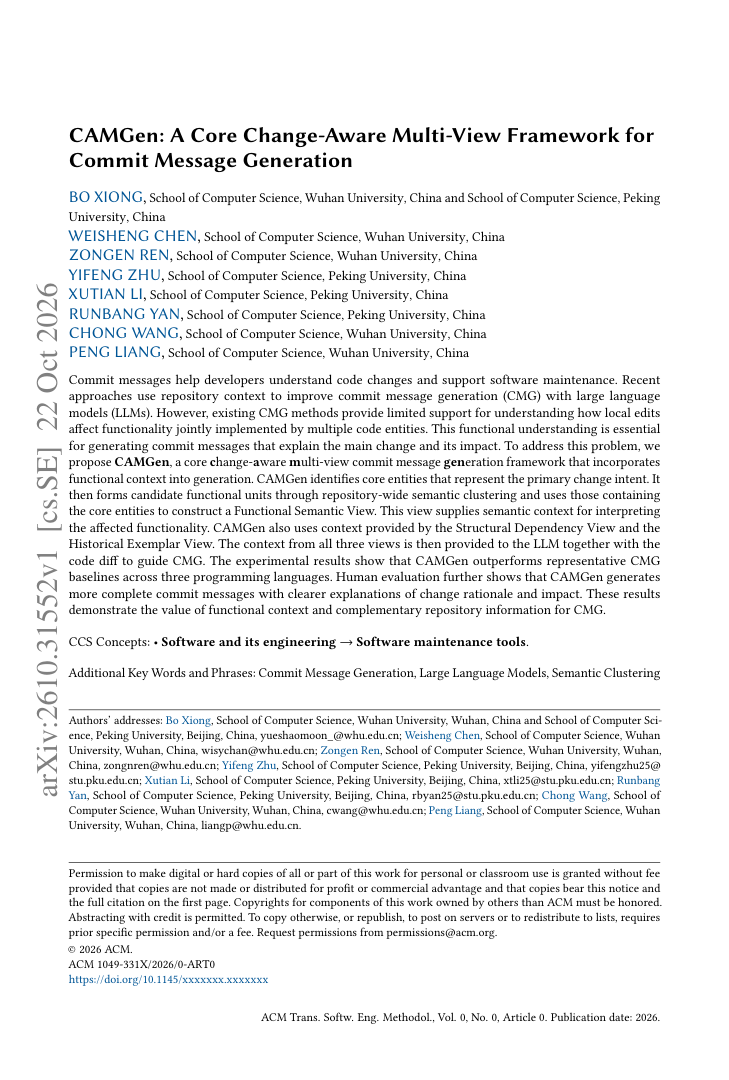
In the fast-paced world of software development, effective communication is key. Commit messages, which developers use to document changes in their code, hold great significance. However, current techniques for auto-generating these messages often fall short. Enter CAMGen, a revolutionary framework designed to enhance the clarity and utility of commit messages by leveraging core change awareness and multi-view repository contexts.
The Essence of Commit Messages
Commit messages serve as essential artifacts providing insights into the modifications made to code bases, facilitating efficient software maintenance and collaboration among developers. Typically, these messages articulate two crucial elements: "what" changes were made and "why" they were necessary. Yet, existing automatic commit message generation methods often struggle to accurately reflect these facets.
Understanding CAMGen
CAMGen stands for Core Change-Aware Multi-View Framework, and it aims to improve the commit message generation (CMG) process by integrating multiple perspectives on code changes. Traditional approaches heavily relied on predefined templates or code diff translations, but CAMGen ushers in a paradigm shift by analyzing the functional contexts surrounding code alterations.
This innovative framework identifies core entities within code changes that indicate primary modification intentions and groups related changes into functional units through semantic clustering. By organizing repository information from different perspectives—including structural dependencies and historical context—CAMGen can guide large language models (LLMs) more effectively during message generation.
Why Functional Context Matters
A key innovation of CAMGen lies in its ability to provide functional context, which integrates implications of code changes across various components. Instead of merely focusing on localized structural elements, CAMGen enhances LLMs' understanding of how changes impact overall system functionality. This understanding allows AI to generate commit messages that not only describe what was changed but also explain the consequences of those changes in a more comprehensive manner.
Breaking Down the Results
In experimental evaluations, CAMGen has shown remarkable improvements over existing CMG methods by leveraging its unique framework. Results reveal that CAMGen-generated commit messages are clearer, more informative, and closely aligned with human-written counterparts. A human assessment highlighted significant improvements in aspects like comprehensiveness, rationality, conciseness, and expressiveness compared to traditional techniques.
Specifically, CAMGen was evaluated across multiple programming languages, revealing its adaptability and robustness. Whether in Java, C++, or Python, CAMGen consistently outperformed previous state-of-the-art models, suggesting its potential to reshape how developers document their code changes.
Conclusion: A Step Toward Better Collaboration
The introduction of CAMGen lays the groundwork for a brighter future in software engineering, where automated tools can aid developers in conveying their intentions succinctly and transparently. By harnessing the power of functional context and a multi-faceted view of code changes, CAMGen not only enhances the automation of commit message generation but also fosters a collaborative environment conducive to better software practices.
As the software landscape continues to evolve, CAMGen presents an exciting leap toward smoothing communication hurdles naturally nestled within the coding process. The exploration of using such functional frameworks signals promising advancements in the realm of automated code documentation.
Authors: Bo Xiong, Weisheng Chen, Zongen Ren, Yifeng Zhu, Xutian Li, Runbang Yan, Chong Wang, Peng Liang


