
Unlocking 3D Placement Genius: The VoxProg Revolution in Spatial Reasoning
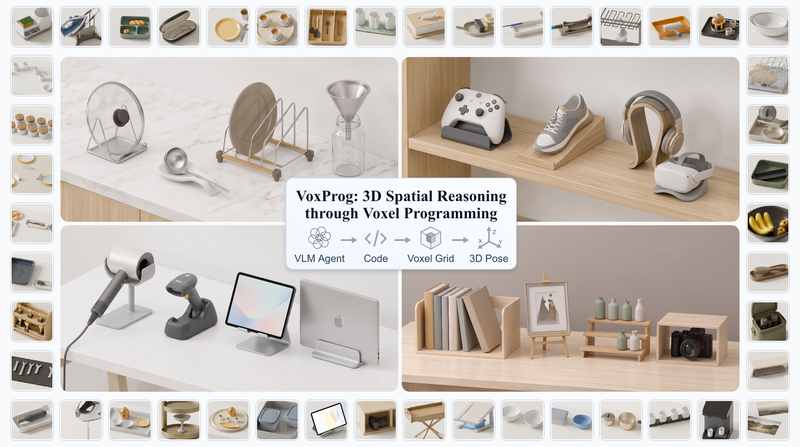
In the realm of artificial intelligence, comprehending spatial relationships remains one of the significant challenges. The recent research paper, fVoxProg: 3D Spatial Reasoning through Voxel Programming, presents an innovative framework that utilizes voxel programming to enhance how language models can interpret and execute spatial tasks. Researchers from Zhejiang University and vivo Mobile Communication Co., Ltd. have developed a method that transforms natural language instructions into executable programs that effectively manage object placements in 3D environments.
The Challenge with Current Spatial Reasoning
Understanding and acting on spatial instructions is not as straightforward as one might think. For example, if asked to place a bottle in a holder, it's not just about locating the holder. The program needs to understand the geometry of both the bottle and the holder. Existing models often struggle with this nuance because they rely on predefined tasks or cannot adequately model complex geometries. This gap leads to inaccuracies in object placement, which can have significant ramifications in fields such as robotics and augmented reality.
Introducing VoxProg: A Breakthrough in Voxel Programming
The VoxProg framework offers a critical advancement by combining natural language processing with 3D spatial reasoning through voxel programming. This approach consists of two main stages: the evidence program and the pose program. The evidence program identifies task-relevant areas in a scene and prepares a reliable model of the environment, while the pose program computes the exact positioning for object placement, leveraging voxel representations.
Unlike previous methods that often work with isolated points or simple geometric representations, VoxProg generates a detailed voxel grid that offers an enriched view of the scene's geometry. This allows for more precise calculations, improving the model's ability to interpret detailed spatial tasks that involve 3D structures.
Performance and Evaluation: Surpassing Traditional Methods
To test its efficacy, VoxProg was evaluated on the VoxProg-Bench, a benchmark consisting of 71 diverse language-guided 3D placement tasks. The results demonstrate a clear advantage: VoxProg consistently outperformed relation-based, keypoint-based, and mesh-based methods. For instance, it scored an impressive 83.10 in Intent Alignment, significantly beating the next closest competitor.
Moreover, in terms of Physical Validity—essentially, how plausibly an object is supported in 3D space—VoxProg achieved 95.8%, marking a substantial improvement over traditional methods which often result in unrealistic placements that can lead to visual overlaps or floating objects.
How VoxProg Works: An Innovative Process
The magic of VoxProg lies in its two-stage process. First, through the evidence program, it creates local voxel views that represent object surfaces in a regular grid format. This means that the model builds a clear picture of where each object can fit based on its relationships to others in the scene. After assembling this detailed spatial representation, the pose program calculates the exact placement using acquired details, adjusting the object's orientation based on the environment.
This dual approach allows VoxProg to generate solutions iteratively, using feedback from visual inspections and numerical checks to refine its code, ensuring that all placements are physically valid and contextually appropriate.
The Future of 3D Spatial Reasoning
The findings from VoxProg not only showcase its superiority in handling complex spatial tasks but also open the door to broader applications in robotics, autonomous driving, and augmented reality systems. By combining language understanding with geometric comprehension, VoxProg sets a new standard for how machines can interpret and execute intricate spatial instructions.
As researchers continue to explore the potential of voxel programming and similar approaches, the landscape of AI-driven spatial reasoning is poised for transformative advancements. This work might very well be the cornerstone of a future where machines seamlessly navigate and interact with our three-dimensional world.
Authors: Zhichao Zhai, Menglei Zhao, Guikun Chen, Zihao Yan, Kanzhi Wu, Wenguan Wang, Jun Xiao


