
Unleashing the Power of Predictive Maintenance: How Smart Compression Techniques Fuel Industry 5.0
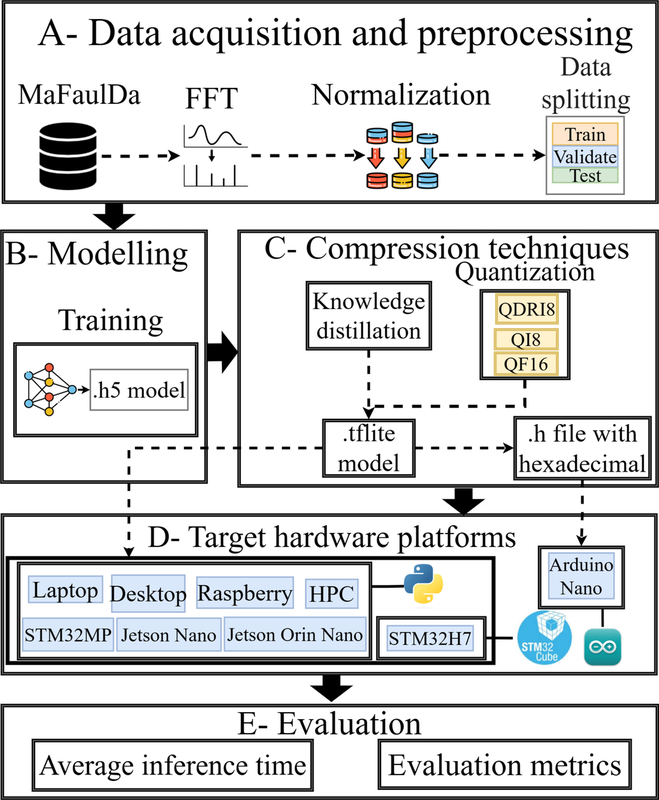
In a world where Industry 5.0 promises smarter factories and more efficient processes, a new research paper by Matheus Calheira Guimarães de Oliveira and colleagues reveals how to optimize deep learning models for predictive maintenance in resource-constrained settings. Their findings illuminate the way forward for using advanced artificial intelligence without overwhelming hardware capabilities, making it easier for industries to transition into more sustainable practices.
The Challenge of Model Compression
As industries increasingly adopt autonomous systems to enhance productivity and sustainability, the need to optimize complex deep learning models becomes crucial. However, these models are often too heavy for the edge devices commonly used in industrial environments, leading to efficiency drops and high energy costs. The authors confronted this issue head-on by benchmarking four advanced model compression techniques on various computing platforms tailored for predictive maintenance of rotating machinery.
A Deep Dive into the Compression Techniques
Among the four compression strategies analyzed, knowledge distillation stood out as the most effective method. This technique involves transferring knowledge from a larger, accurate model (the teacher) to a smaller model (the student) without losing significant predictive capabilities. Remarkably, the study demonstrated a speed increase of over 90% across different devices while achieving a 91.22% balanced F-score, alongside a staggering 98.9% reduction in model size.
Real-World Applications: The Key to Sustainable Industry
The implications of these findings for predictive maintenance are profound. By utilizing advanced model compression techniques, industrial operators can harness the full potential of AI on edge devices, allowing for real-time monitoring and actionable insights to prevent equipment failures. Furthermore, this can lead to significant cost savings and reduced energy consumption, supporting the environmental goals associated with Industry 5.0.
Evaluating Across Diverse Platforms
This comprehensive study was unique in its approach to testing across nine heterogeneous computing platforms, ranging from microcontrollers to high-performance processors. By evaluating the compressed models under these varied conditions, the authors highlighted not only the versatility of deep learning models but also underscored the need for tailored solutions that consider the specific constraints and capabilities of different hardware.
Ultimately, the research emphasizes that achieving efficient predictive maintenance solutions does not have to come at the cost of performance. The methodologies developed here pave the way for industries to align with sustainable practices and prove that advanced technology can be both affordable and effective in enhancing operational resilience.
With these groundbreaking insights into model compression and its relevance in real-world situations, the paper by Oliveira et al. champions the future of intelligent manufacturing, where the harmonious interplay between AI and resource efficiency leads to a more sustainable industrial landscape.
Authors: Matheus Calheira Guimarães de Oliveira, Marco Aurélio da Silva Cruz, Regis Cardoso, Lucas Cambuim, Rafael Macieira, Arthur Paim, Helaine Neves, Alex Santos, Lilian Guarieiro, Jean Schmith, Prashant Kumar, Erick G. Sperandio Nascimento


