
Unleashing Efficiency: How TraceLite is Transforming Software Engineering Agent Performance
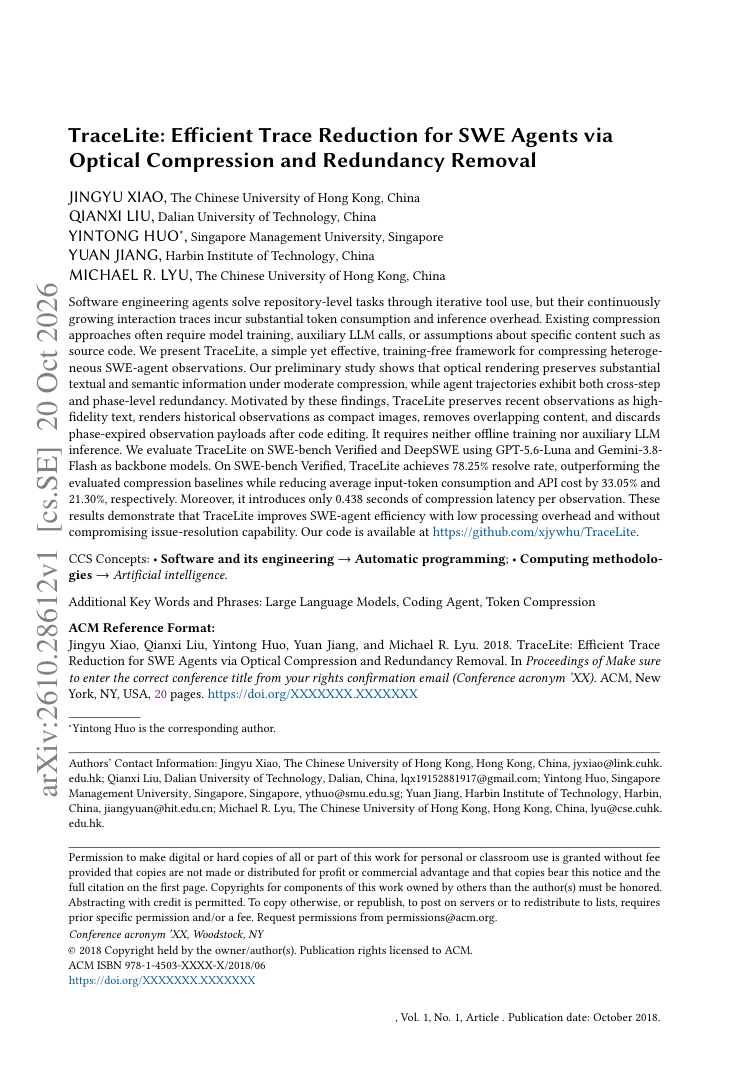
In the ever-evolving landscape of software development, the use of software engineering (SWE) agents has accelerated the way developers tackle coding issues. However, as these agents interact more and more with repositories to resolve tasks, they produce extensive interaction traces, leading to increased computational costs and inefficiencies. A recent study introduces TraceLite, a novel framework that promises to streamline these interactions by effectively compressing the data SWE agents generate, thereby enhancing their performance without the need for additional training or external model dependencies.
The Challenge of Growing Interaction Traces
As SWE agents operate iteratively—searching through code repositories, executing commands, and inspecting outputs—their interaction traces can become overwhelmingly large. Traditional methods of data handling often require either extensive training or additional computational resources to filter out redundant or outdated information. TraceLite tackles this challenge head-on by employing a hybrid approach that utilizes optical compression and redundancy removal, ensuring the retention of essential information while significantly reducing unnecessary data.
How Does TraceLite Work?
TraceLite operates by dividing agent interactions into two critical windows: a recent window, where the last few observations are maintained in high fidelity, and a historical window, where previous observations are rendered as compact images. By preserving the most relevant data and compressing older, less relevant information, TraceLite minimizes token consumption—the units of data processed—without sacrificing the agent's ability to resolve issues.
Key Findings from Evaluations
The results of the preliminary study are impressive. On the SWE-bench Verified dataset, TraceLite achieved a remarkable 78.25% resolve rate, significantly outperforming existing compression methods. Furthermore, it reduced average input token consumption by 33.05%, leading to lower API costs by 21.30% without compromising speed, introducing only 0.438 seconds of additional latency for each observation.
This framework not only streamlines computational processes but also enhances SWE agents' problem-solving effectiveness, making it a potential game-changer in software engineering.
Implications for Software Development
With agents like TraceLite reducing the load on computational resources and improving issue resolution times, this innovation has far-reaching implications for the software industry. Developers can expect faster debugging processes, more efficient coding cycles, and ultimately, higher productivity. By embracing solutions like TraceLite, companies can harness the full potential of AI-powered coding agents while minimizing their operational overhead.
Conclusion
The launch of TraceLite marks a significant advancement in the efficiency of SWE agents by simplifying the data they generate and process. As software development becomes more data-driven and multifaceted, innovations like TraceLite pave the way for smarter, faster, and more cost-effective coding solutions. For more detailed insights and to explore the underlying framework, the code is available at TraceLite GitHub repository.
Authors: Jingyu Xiao, Qianxi Liu, Yintong Huo, Yuan Jiang, Michael R. Lyu.


