
Transforming Warehouse Automation: How Industrial ReMEmbR Creates a Smarter Robot Fleet Memory System
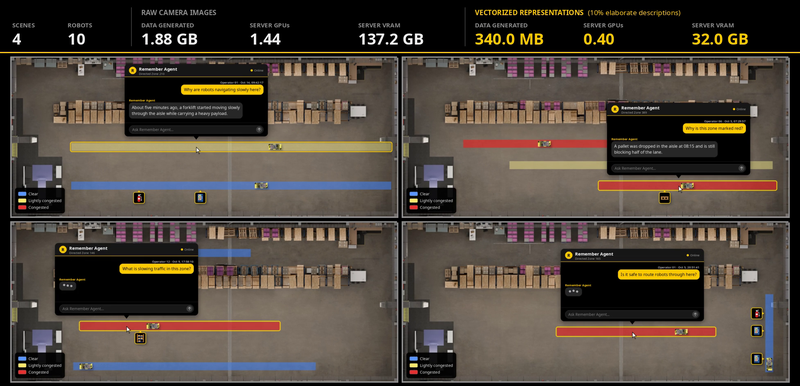
In the rapidly evolving landscape of warehouse automation, optimizing the efficiency of robot fleets is essential. A new research paper, "Industrial ReMEmbR: Scaling Spatiotemporal Memory to Robot Fleets," introduces a groundbreaking shared memory system designed to empower fleets of robots with enhanced computational capabilities. The research team, comprised of members from Idealworks and NVIDIA, tackles the perennial challenge of efficiently storing and utilizing the vast amounts of visual data generated during warehouse operations.
The Challenge of Observational Memory
Warehouse robots are continuously capturing video footage of their environment, which includes valuable observations on traffic patterns, obstacles, and operational conditions. However, the burden of processing and storing this video in real-time poses significant computational, communication, and storage challenges. To put this into perspective, recalling critical insights—such as identifying common aisle blockages—often involves extensive data reviews that are time-consuming and resource-intensive.
Introducing Industrial ReMEmbR
The proposed solution, Industrial ReMEmbR, revolutionizes the memory management of robotic systems. By harnessing a shared spatiotemporal memory, the system allows each robot to encode video clips in a way that optimally balances the computational load across the fleet. Rather than continuously uploading raw video, robots encode critical information locally and share it efficiently.
For instance, when a robot manages to detect an obstacle, it captures this information as a compressed representation—like a digital fingerprint—without sending the entire video frame to a server. This innovative approach not only saves bandwidth but also enables real-time insights, building a dynamic memory that other robots in the fleet can access instantly.
Optimizing Performance with Innovative Technology
The encoding process utilizes NVIDIA’s advanced models, including Cosmos-Embed1 and Cosmos3-Edge, which allow robots to generate embeddings or 'memory tags' for scenes. A notable feature is the integration of the Nemotron agent, which performs intelligent retrieval tasks swiftly and efficiently. This system significantly enhances the robot fleet's ability to adapt to changing warehouse conditions while minimizing server-side computational demands.
By splitting the models between the robots and the central server, Industrial ReMEmbR creates a seamless architecture that ensures a constant flow of contextual data. Robotics operators can query this shared memory to gain real-time insights about the operational environment, thus enhancing decision-making processes and operational strategies.
Results of the Implementation
In experiments, Industrial ReMEmbR has demonstrated remarkable improvements in accuracy and computational efficiency. The new system was able to classify live traffic conditions in warehouses with a balanced accuracy of 71.3%, outperforming traditional methods which relied heavily on caption-based descriptions. This achievement indicates that reducing dependency on text generation—yet retaining quick access to live data—significantly enhances overall operational efficiency.
Future Prospects
The implications of Industrial ReMEmbR extend far beyond mere memory management. Its modular architecture stands poised to address various future challenges, including navigation optimization, congestion-aware fleet planning, and perhaps even training models for predictive maintenance. As the automation and robotics industries continue to grow, systems like Industrial ReMEmbR pave the way for not just smarter robots, but also smarter operational strategies within warehouses and beyond.
In conclusion, Industrial ReMEmbR signifies a monumental step forward in how robotic fleets can intelligently remember and utilize their surroundings, fundamentally transforming warehouse automation and setting new benchmarks in operational efficiency.
Authors: Jad Yammine, Malek Wahidi, Abrar Anwar, Yan Chang, Mihir Acharya, Anthony Rizk


