
Transforming Texture Analysis: How TexFlow is Revolutionizing Crystallographic Modeling on the SO(3) Manifold
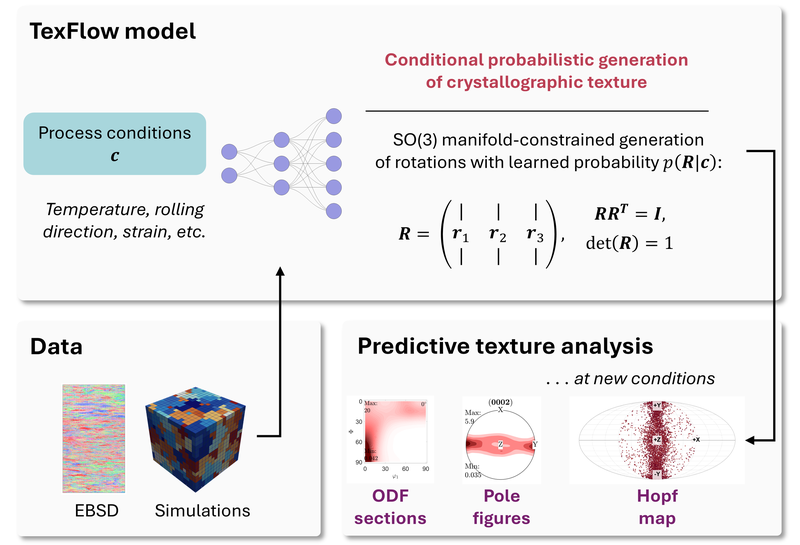
In the world of materials science, understanding crystallographic texture is pivotal. It refers to the statistical distribution of grain orientations in polycrystalline materials, influencing material properties and performance. A recent study introduces TexFlow, an innovative framework that leverages machine learning to model this texture directly on the rotation group SO(3), overcoming limitations of traditional analysis methods.
Why Texture Matters
Crystallographic texture plays a key role in dictating the mechanical properties of materials. Different textures yield varied responses to stress or strain, directly impacting durability, flexibility, and strength. Traditional analysis methods often rely on complex orientation distribution functions (ODFs) and require extensive experimental data that can be costly and time-consuming to obtain.
The Challenge of Traditional Methods
Conventional texture analysis methods use pole figures and ODFs that, while effective, do not provide a direct predictive modeling framework. Hence, there's a significant gap in linking process parameters, structure, and properties effectively. Machine learning offers a promising alternative, but existing techniques often fail to incorporate the unique geometric properties of rotations due to their reliance on Euclidean systems.
Introducing TexFlow
TexFlow addresses these challenges by employing a conditional normalizing flow framework specifically designed for the SO(3) manifold. The method encodes rotations using a six-dimensional Gram-Schmidt orthogonalization representation, enabling it to learn a probability distribution over rotations in a structured manner. This innovative approach allows for predictive modeling that is both efficient and effective, opening avenues for enhanced material design and analysis.
What Sets TexFlow Apart?
The key strengths of TexFlow lie in its ability to represent complex multimodal textures and their evolution under varying processing conditions. By incorporating parameters such as temperature or deformation state directly into its modeling framework, TexFlow facilitates conditional probabilistic modeling that was previously unattainable.
Additionally, the framework introduces Hopf-fibration visualizations, which present a compact global view of texture. This alternative visualization method transcends conventional approaches like pole figures, helping to mitigate ambiguities that often arise when analyzing crystal textures.
Validation and Results
The TexFlow framework has been extensively validated on both experimental and simulated datasets encompassing various material systems, including additively manufactured stainless steel, forsterite, and copper. In all cases, TexFlow effectively captured the subtleties of crystallographic texture, demonstrating a very high degree of correlation with ground-truth data.
Moreover, the framework excels in interpolation and extrapolation tasks, predicting textures for unobserved processing conditions with impressive accuracy. This ability not only enhances material characterization but also aids in optimizing processing parameters for desired material properties.
Future Applications and Potential
The introduction of TexFlow marks a significant step forward in the field of materials science. Its potential applications span from texture data augmentation to developing robust maps linking processing conditions and material properties. As materials science increasingly leans towards data-driven methods, TexFlow stands to revolutionize how we understand and manipulate material textures.
In conclusion, TexFlow is not just a tool for texture analysis; it is a beacon for future enhancements in material science, paving the way for smarter, more efficient methods of understanding the microstructures that define the materials we rely upon daily.
Authors: Gowtham Nimmal Haribabua, Tarakram Ramgopala, Divakar Vetriveerana, Siddhant Kumara
Affiliation: Department of Materials Science and Engineering, Delft University of Technology, 2628CD Delft, The Netherlands


