
Transforming Image Editing: How "Thinking in Boxes" makes 3D Manipulation Effortless
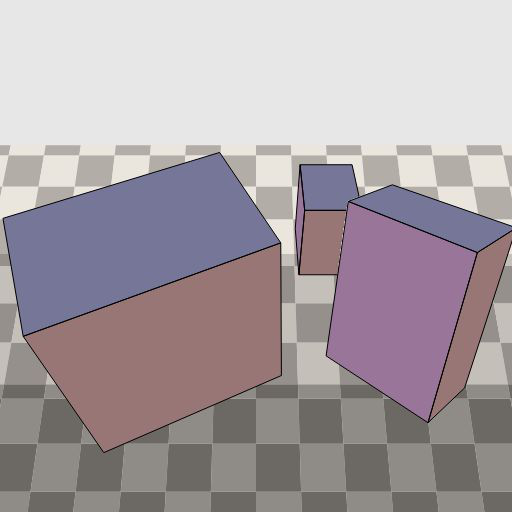
In a groundbreaking study led by a team of researchers from institutions including the Indian Institute of Science and Johns Hopkins University, a revolutionary image editing tool has emerged that simplifies the complexities of 3D editing in real images. Titled "Thinking in Boxes: 3D Editing in Real Images Made Easy," this paper unveils an innovative approach that allows users to manipulate images by providing intuitive control over object placement, rotation, and scaling through the use of 3D boxes.
The Challenge of 2D Image Editing
Traditionally, image editing has relied on 2D conditioning interfaces, which often leave users struggling with vague controls when it comes to spatial transformations. As camera angles change or objects shift dramatically, the editing process can become cumbersome, leading to frustrating outcomes. An example of this is attempting to rotate an object while keeping its background consistent—something complex and tricky in prior methods.
What is "Thinking in Boxes"?
The concept introduced by the researchers transforms image editing into a more geometric, user-friendly task. By utilizing 3D boxes that users can position around objects of interest, the editing process is significantly streamlined. The user defines where they want an object to be and how they want it to be transformed by simply adjusting the 3D boxes—essentially casting the editing challenge into a well-defined geometry problem.
How It Works
This system incorporates a depth-aligned planar floor—a global reference frame that helps afford clarity in editing actions. Each face of the boxes is color-coded to indicate orientation, which allows the algorithm to understand how to translate, rotate, or scale the objects within the scene. This means that changes are not just visually appealing but also contextually correct, preserving elements of the scene that would typically be lost during conventional edits.
The Impressive Outcomes
The efficacy of this method is backed by a two-stage training process. Initially, synthetic multi-object scenes are used to train the model, followed by fine-tuning with real-world videos. As a result, the system demonstrates robust performance, achieving results that significantly surpass those of existing state-of-the-art methods. With "Thinking in Boxes," users can perform complex edits—including object rotations and adjustments—while ensuring that the object appearance and the surrounding scene integrity are maintained, even for parts of the objects previously hidden from view.
Why This Matters
This innovative 3D editing solution opens the door to new avenues in both professional and creative domains, such as photography, graphic design, and artificial intelligence, by vastly simplifying complex editing tasks. As image editing tools continue to evolve, concepts like "Thinking in Boxes" promise to create technology that aligns more closely with natural user interactions, making sophisticated edits possible for everyone.
For more information and to see this tool in action, you can visit their project page.
Authors: Pradhaan S Bhat, Naveen Chandra R, Rishubh Parihar, Vaibhav Vavilala, R. Venkatesh Babu, D.A. Forsyth, Anand Bhattad




