The Rise of the "Midweek Mountain": How Hybrid Work is Redefining America's Office Culture
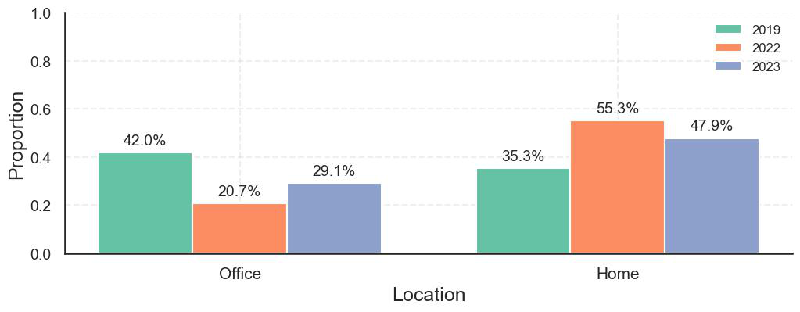
A groundbreaking study led by researchers Norman Guo, Wei Jiang, Yaswanth Pothuru, and Baozhong Yang reveals dramatic shifts in workplace patterns post-pandemic, based on an exhaustive analysis of approximately 41 billion mobile geolocation records. The findings not only highlight a decline in office attendance but also introduce a fascinating new concept known as the "midweek mountain."
Understanding the Shift: From Office to Hybrid Work
Before the COVID-19 pandemic, office attendance was a staple of the American work culture, with 42% of workdays spent in the office. However, by 2022, this figure plummeted to just 20.7%, only rebounding slightly to 29.1% in 2023. This study underscores a transition from traditional office settings to a hybrid model where employees exhibit a significant increase in time spent working from home.
The Emergence of the "Midweek Mountain"
The research highlights an intriguing new trend: a peak in office attendance occurring from Tuesday to Thursday, which the authors aptly name the "midweek mountain." This phenomenon suggests that companies and employees are gravitating toward a concentrated work schedule during the middle of the week, with Mondays and Fridays becoming increasingly reserved for remote work.
Exploring Time Allocation: Work and Leisure Blurred
Another notable finding from the study is the increasing tendency for workers to blend work with leisure during the workday. Employees who worked from home tended to spend more time at public spaces such as parks and malls. This shift reflects a redefined relationship between work and personal life, showcasing that remote work isn’t merely about location; it’s also about how we choose to spend our time.
Implications for the Future of Work
The insights from this research call for organizations to reevaluate their policies around remote and hybrid work. As employees increasingly opt for a mix of in-office and remote work, companies may need to consider flexible schedules that embrace the midweek mountain trend. Urban planners and policymakers must also take note of these shifts, as they have significant implications for the design of public spaces and local economies.
By leveraging real-time geolocation data, this study provides a comprehensive view of how work patterns are fundamentally changing, proving that the pandemic has indeed catalyzed a long-lasting transformation in the workplace that extends beyond mere adjustments to COVID-era restrictions.
For those interested in the future of work, understanding these patterns can offer a competitive edge in shaping workplace strategies that align with evolving employee expectations and societal norms.
Authors: {Norman Guo, Wei Jiang, Yaswanth Pothuru, Baozhong Yang}

