
The Future of Game Theory: Exploring Optimal Coarse Correlated Equilibria in Mean Field Games
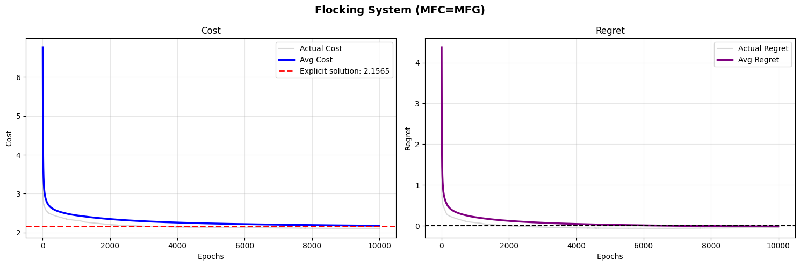
Recent research by Luciano Campi, Federico Cannerozzi, and Ioannis Tzouanas reveals groundbreaking insights into mean field games (MFGs), a framework that extends the conventional concept of Nash equilibria to encompass interactions among large populations of agents. Their paper, "Optimal Coarse Correlated Equilibria in Mean Field Games: Linear Programming and No-Regret Learning," introduces optimal coarse correlated equilibria (CCEs), providing a new lens through which we can analyze strategies in these complex systems.
Understanding Coarse Correlated Equilibria
A coarse correlated equilibrium can be viewed as a recommendation from a moderator, guiding agents in their strategies without mandating them. Typically, players receive a strategy while considering the likelihood of the actions of others without observing the moderator's actual recommendation. This study formalizes the concept and outlines how an optimal CCE can be selected based on specific performance criteria, which may differ from the objectives of individual players.
Key Contributions and Methodology
The authors develop a linear programming (LP) formulation to identify optimal CCEs, proving their existence under particular conditions. This dual approach combines statistical learning, through linear programming and no-regret algorithms, allowing for an adaptive strategy that ensures players can learn and adjust their actions to minimize regret over time. The use of no-regret learning is particularly notable; instead of calculating best responses to estimated behaviors, agents focus on recommendations that yield better outcomes than fixed strategies.
Linear Programming Formulation
The research establishes a linear programming structure to analyze the optimal coarse correlated equilibria, which facilitates both existence results and calculations of CCEs. The authors show that the relationships among recommended strategies can be characterized by deterministic flows, enhancing our understanding of how agents behave collectively in large systems.
No-Regret Learning Algorithm
This study introduces a novel no-regret primal-dual learning algorithm tailored for continuous-time environments. Through iterative updates, the algorithm generates recommendations that converge toward optimal behavior dynamically influenced by ongoing player interactions rather than static assumptions.
Implications and Applications
The implications of this research extend far beyond theoretical considerations. The framework could significantly impact fields such as economics, strategic decision-making, and any scenarios involving large-scale interactions. The interplay of optimal strategies defined by coarse correlated equilibria can potentially lead to enhanced cooperative behaviors in economics while ensuring that individual actions remain incentivized to align with collective well-being.
In conclusion, Campi, Cannerozzi, and Tzouanas's exploration into optimal coarse correlated equilibria not only enriches the theoretical foundation of game theory but also opens avenues for practical applications in multiple domains, pushing the boundaries of how we understand strategic interactions in large populations.
To read the full paper, refer to the development listed under arXiv:2606.20062v1 [math.OC].
Authors: Luciano Campi, Federico Cannerozzi, Ioannis Tzouanas




