
SurveyGraph: The Future of Automated Academic Survey Generation is Here!
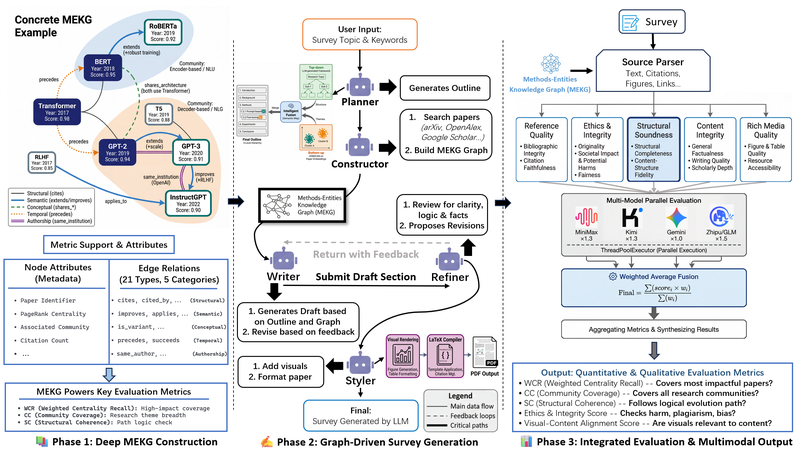
In the fast-paced world of scientific research, where the volume of publications grows exponentially, the ability to generate comprehensive and coherent academic surveys is becoming increasingly vital. Researchers Yifan Yuan, Yancheng Zhu, Zuoyu Zhang, and Xiaogang Peng from Shenzhen University have taken a significant leap in this domain with their innovative framework called SurveyGraph. This paper details how they use a novel Methods-Entity Knowledge Graph (MEKG) to enhance automated survey generation.
Understanding the Challenge
Currently, automated survey generation processes often rely on flat retrieval systems that limit their effectiveness. These systems fail to capture the intricate relationships and evolving structures within research fields, resulting in surveys that lack coherence and depth. The authors aim to address this bottleneck by introducing SurveyGraph, which uses a MEKG to enhance the retrieval of relevant scientific literature based on method-level relationships.
The Methods-Entity Knowledge Graph (MEKG)
At the heart of SurveyGraph is the MEKG, which encodes relationships among various methods, tasks, datasets, and other entities. This structure allows the system to understand how different research works build on or compete with one another, creating a more nuanced representation of the academic landscape. By categorizing these relations into types such as 'extends' and 'improves', the MEKG becomes a powerful tool for identifying core papers and guiding the outline generation process.
Key Innovations of SurveyGraph
The SurveyGraph framework is designed to be multi-faceted. It does not just retrieve papers; it analyzes their relationships, generates structured outlines, and synthesizes narratives relevant to a given research topic. The authors have put SurveyGraph through rigorous evaluations, demonstrating that it substantially improves recall rates—by nearly 100% in certain tests—compared to traditional flat retrieval methods. Such performance indicates that the MEKG introduces a layer of depth previously unavailable in automated academic surveys.
Evaluation and Findings
The authors conducted extensive evaluations of SurveyGraph, utilizing a varied set of benchmarks to assess its performance. The results indicate impressive gains in both recall and structural coherence. For example, during their controlled experiments, the MEKG-driven retrieval method not only increased the number of relevant papers retrieved but also enhanced the structural density of the outputs, making them more informative and cohesive.
Practical Implications
The implications of SurveyGraph are far-reaching. As the researchers highlight, the ability to generate well-structured academic surveys quickly could save scholars considerable time and effort. This is especially crucial in disciplines where staying updated with recent developments is vital. With SurveyGraph, there's a potential for a significant shift in how academic surveys are produced, potentially augmenting scholarly communication and collaboration.
Conclusion
The introduction of SurveyGraph marks a significant advancement in the realm of automated survey generation, presenting a framework that not only retrieves literature but also comprehensively analyzes and synthesizes it. This innovation could redefine how researchers approach academic surveys, making the process faster, clearer, and more aligned with the intricate realities of scientific progress.
For further exploration, the authors have made the code and artifacts available for use, making it easier for others to build upon their work and enhance the academic landscape further.


