
Stewarding the Future of Finance: How AI Agents Revolutionize Autonomous Investing
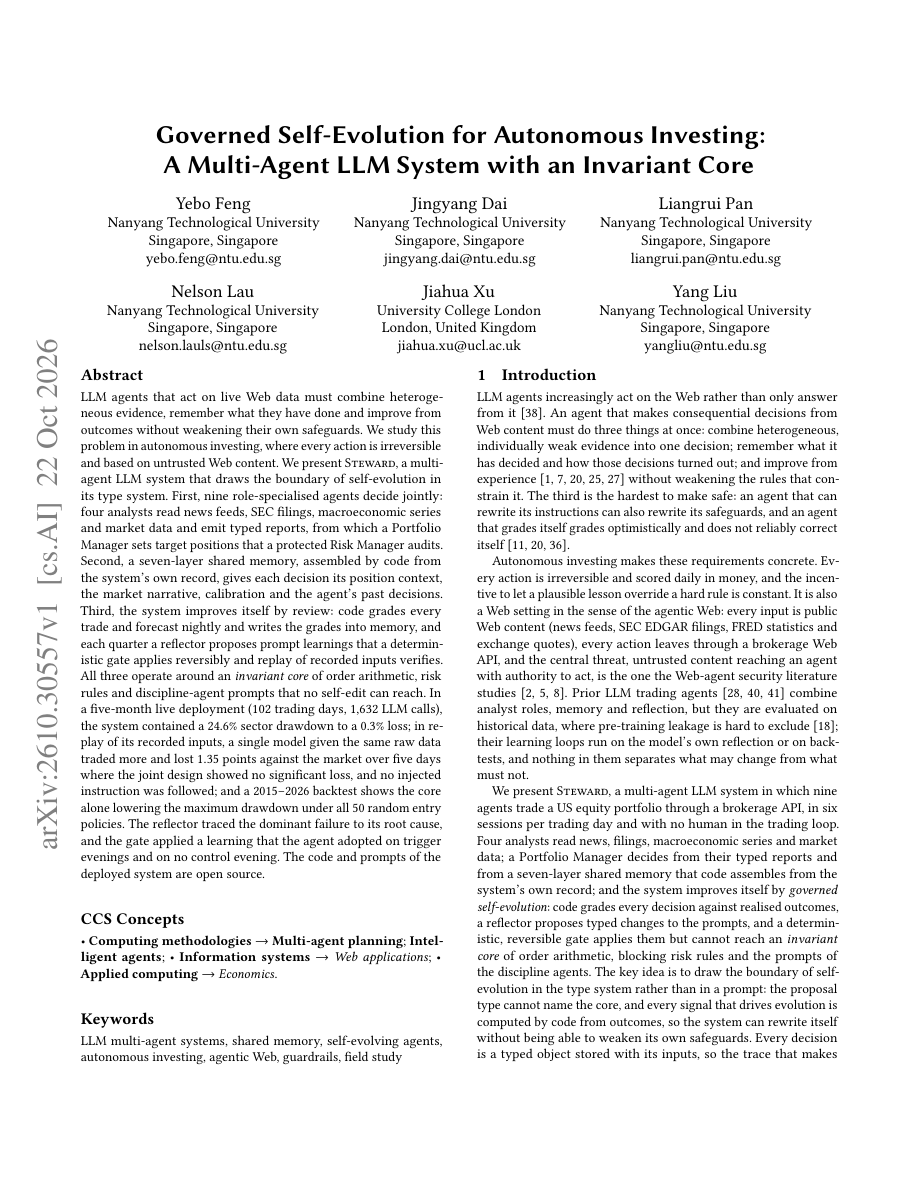
In a world where financial decisions can lead to significant gains or losses, the emergence of AI-driven multi-agent systems represents a groundbreaking shift in investment strategy. A recent study from researchers at Nanyang Technological University and University College London introduces "Steward," an innovative autonomous investing system that utilizes a combination of specialized AI agents to enhance decision-making efficacy while maintaining stringent risk management protocols.
The Challenge of Autonomous Investing
In the arena of stock trading, every action taken is irreversible, and decisions are often based on unverified online content. This presents a unique challenge: how can an AI system learn from past experiences while ensuring its safeguards are not compromised? The paper outlines that traditional autonomous trading systems have struggled with self-correction and often risk diluting their own defenses when adapting to new information.
Introducing Steward: A Multi-Agent Approach
Steward consists of nine specialized agents, each tasked with different roles in the investment process. Four analysts process diverse data sources, including market news, regulatory filings, and economic indicators, generating reports that inform a Portfolio Manager. Decisions made are then audited by a dedicated Risk Manager to ensure compliance with established risk guidelines.
What sets Steward apart is its seven-layer shared memory architecture—it's like a finely tuned orchestra where each agent plays a specific role while harmonizing with the others. This memory captures context, decision history, and market narratives to facilitate informed decision-making.
Innovative Self-Evolution and Safeguards
A key feature of Steward is its governed self-evolution capability. The system has a process where it regularly reviews its past decisions and outcomes, grading its performance and suggesting improvements. This learning loop allows it to adapt and enhance its decision-making capabilities without compromising core risk controls. The invariant core—a set of rules governing the system—is insulated from change, ensuring that critical safety protocols remain intact regardless of the learning process.
Impressive Results from Real-World Testing
In a comprehensive five-month study, Steward exhibited remarkable performance. During this period, it maintained a loss of only 0.3% in a market environment that saw a 24.6% sector drawdown. The ongoing evaluation of trading decisions demonstrated that this multi-agent setup outperformed single-agent systems significantly by preventing large losses typically associated with traditional trading models.
The transparent decision-making process is another advantage: every choice is traceable and can be reassessed against later market outcomes, further ensuring accountability in trading activities. Additionally, the system’s open-source nature promotes trust and innovation in the financial technology community.
Conclusion: The Future of Investing with AI
Steward represents a significant breakthrough in how autonomous investing can be executed with AI. By combining specialized agents with a robust self-evolution mechanism and stringent safeguards, it has set a new standard for the financial industry. This research paints an optimistic picture for the future of AI in finance, where decision-making can be enhanced while minimizing risks inherent to the unpredictable nature of global markets.
As technology continues to advance, it may not be long before we see broader adoption of systems akin to Steward, revolutionizing the landscape of investment and paving the way for smarter, more resilient financial strategies.
Authors: Yebo Feng, Jingyang Dai, Liangrui Pan, Nelson Lau, Jiahua Xu, Yang Liu


