
Soaring to New Heights: Meet DiffDreamer, the Game-Changer in Quadrotor Control
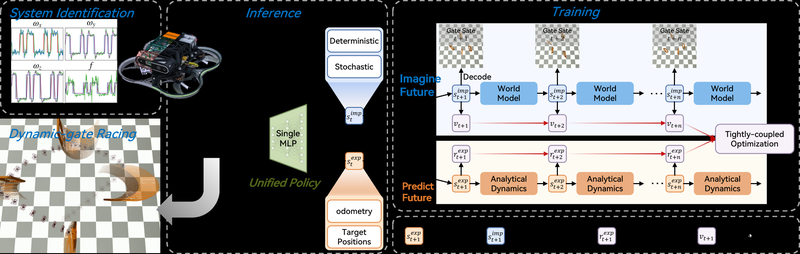
In a groundbreaking study published in the IEEE Robotics and Automation Letters, a team of researchers introduced a novel framework called DiffDreamer, which promises to revolutionize the way quadrotors—small drones capable of agile flight—perform tasks in dynamic environments. This innovative approach couples world models and differentiable simulation, enabling quadrotors to execute complex maneuvers with unprecedented precision.
The Challenge of Agile Flight
Tasks like dynamic gate racing, where a quadrotor must navigate through moving obstacles at high speeds, require not only exceptional control but also the capability to predict environmental changes. Traditional methods often segment the process into isolated modules for perception, planning, and control, leading to inefficiencies and potential errors in high-pressure scenarios.
What Makes DiffDreamer Unique?
DiffDreamer stands out by integrating a learned world model—which predicts external dynamics—with a differentiable simulator that accurately reflects the robot’s physical movements. This dual-pathway approach allows the system to optimize control more accurately and quickly compared to existing methods. The architecture lets the quadrotor learn from both its environment and its internal dynamics simultaneously, reducing the learning burden typically placed on the world model.
Enhancing Training Efficiency
The researchers conducted various experiments testing DiffDreamer’s performance in tasks such as aggressive tracking and dynamic-gate racing. The results were impressive; DiffDreamer not only converged faster during training than its model-free and other model-based counterparts, but it also achieved superior final results. This performance leap suggests that the method’s fusion of projected external dynamics and precise physical control could be a key factor in future quadrotor technologies.
Real-World Validation
Perhaps one of the most significant aspects of the DiffDreamer framework is its successful application in real-world scenarios. The researchers conducted flight tests that validated the effectiveness of their method under practical conditions, moving beyond theoretical or simulated environments. This transition underscores the potential for DiffDreamer to be deployed in various applications ranging from search and rescue operations to high-speed racing and beyond.
Conclusion: The Future is Here
The introduction of DiffDreamer could signify a significant leap forward in robotic flight control technology. By marrying sophisticated predictive capabilities with robust physical simulation, this new framework sets the stage for more autonomous and capable aerial vehicles. As researchers continue to explore and refine this innovative approach, we can expect to see broader applications and deeper integrations of such technologies across various fields.
Authors: {Fanxing Li, Yuxiang Huang, Shengyang Wang, Fangyu Sun, Shuyu Wu, Tianbao Zhang, Dexin Zuo, Yan Yufei, Danping Zou, Wenxian Yu}


