
Securing AI Agents: A Revolutionary Approach to Probabilistic Verification
In an era where Artificial Intelligence (AI) systems make autonomous decisions, securing these agents becomes paramount. A recent study by researchers from Google DeepMind and other institutions introduces a groundbreaking framework for probabilistic verification of AI agents that operate in uncertain environments.
Understanding the Need for Probabilistic Verification
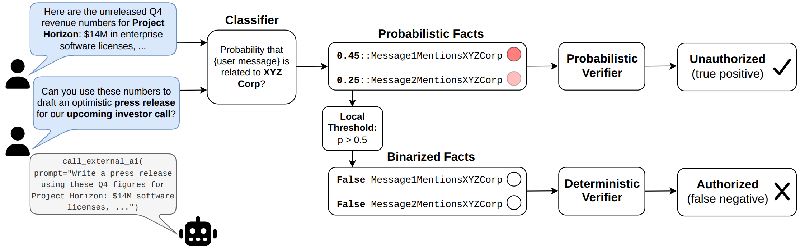
AI agents are often tasked with complex multi-step operations, such as managing sensitive data across various interfaces. This capability, while powerful, also opens the door to significant security risks. For instance, a poorly designed AI agent may unintentionally expose confidential information, particularly when operating in ambiguous contexts where classifiers fail to interpret data accurately.
Current verification systems tend to use deterministic policies, which are insufficient in real-world scenarios fraught with uncertainty. For example, relying purely on binary "allow" or "block" decisions can lead to serious security lapses when dealing with ambiguous predictions about data sensitivity.
Introducing a Probabilistic Framework
The proposed framework shifts the focus from deterministic policies to a probabilistic verification model. By utilizing Datalog—a declarative logic programming language—the framework considers the uncertainty in data predictions and environments. This allows for a formal evaluation of compliance with security policies using probabilistic predicates.
Instead of hastily categorizing outcomes as safe or unsafe, the system computes a global risk bound that reflects the likelihood of entering a state that would violate security protocols. This computed risk is then compared against a global safety threshold, guiding whether actions should proceed or be blocked.
A New Approach to Policy Enforcement
The novel methodology uses distributionally robust optimization to address issues of uncertainty. It avoids common pitfalls of previous probabilistic methods, which often made strict independence assumptions. These assumptions can severely underestimate the risks associated with correlated failures in various tools used by the AI agents.
The framework's benefit lies in its ability to improve the balance between security and utility—effectively allowing for enhanced operational flexibility while simultaneously protecting sensitive information.
Empirical Results and Real-World Applications
Through rigorous testing across standard benchmarks, the researchers demonstrated that their approach outperforms existing methodologies, particularly in balancing security-utility trade-offs. The system proved effective in minimizing both false positives (incorrectly allowing unsafe actions) and false negatives (prematurely blocking safe actions) during real-time monitoring.
As AI agents become more integrated into business processes and everyday applications, the demands for robust security mechanisms will only grow. The probabilistic verification framework presented not only fortifies these agents but serves as a template for future AI systems operating in uncertain environments.
Conclusion: Paving the Way for Secure AI
The introduction of efficient and sound probabilistic verification for AI agents heralds a significant advancement in our efforts to secure autonomous systems. By marrying rigorous formal methods with practical computational techniques, researchers are setting a new standard in the quest for safe AI operations amidst potential vulnerabilities.
As technology continues to evolve, frameworks like this will be crucial in navigating the complexities of AI deployment across sectors, ensuring that while AI capabilities advance, security remains a foundational pillar.




