
Revolutionizing Space Research: Introducing AutoResearch, the Auditable LLM-Driven Agent for Aerospace Autonomy
In the ever-evolving field of aerospace engineering, the integration of artificial intelligence has taken a significant leap forward with the introduction of AutoResearch. A groundbreaking framework developed by researchers Amit Jain and Richard Linares at the Massachusetts Institute of Technology (MIT), AutoResearch aims to streamline the development of control policies for spacecraft. Utilizing a large language model (LLM), this innovative approach not only simplifies the research loop but also ensures the credibility and authenticity of the results.
The Challenge of Aerospace Control Policies
Traditionally, creating effective guidance, navigation, and control functions for spacecraft has been a complex and labor-intensive process. Engineers would carefully select architectures and parameters, conduct numerous experiments, and grapple with the uncertainty of whether improvements stem from genuine advancements or simply random variations known as "seed noise." AutoResearch aims to change this by automating the experimental process for aerospace control problems while ensuring statistical rigor.
How AutoResearch Works
At its core, AutoResearch automates the entire research process through a systematic loop. The LLM acts as an offline agent that reads problem descriptions, proposes modifications to training scripts, executes changes, and analyzes outcomes. However, what sets AutoResearch apart is its built-in credibility layer, which ensures that reported results are not only genuine but also statistically validated.
Each proposed result must pass three crucial checks: it must clear the established seed noise for the problem, be verified through reseeding of configurations, and undergo a leave-one-out pruning process to identify which changes actually contributed to improvements.
Key Contributions of AutoResearch
1) **Reusable Framework:** AutoResearch establishes a standardized methodology for research problems, enhancing efficiency by allowing the same framework to be applicable across various aerospace control challenges.
2) **Credibility Assurance:** The credibility layer integrates a rigorous evaluation of seed noise and adopts a systematic approach to verifying results, thereby maintaining the integrity of the research process.
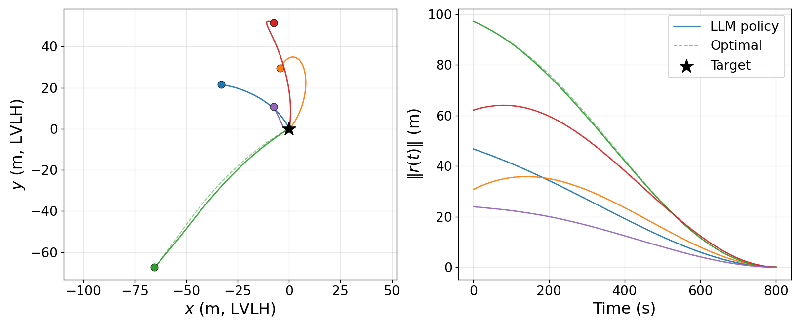
3) **Demonstrated Success:** In practical applications, such as the Clohessy-Wiltshire relative rendezvous and collision-avoidance docking problems, AutoResearch distinctly trailed traditional undirected searches, yielding policies that outperformed previously known benchmarks and maintained compliance with strict safety regulations.
Real-World Applications and Future Prospects
The implications of AutoResearch extend far beyond theoretical advancements; they have tangible applications in spacecraft autonomy. By ensuring that learned control policies are genuinely effective, the framework paves the way for safer and more reliable space missions. Future iterations of AutoResearch aim to enhance its capabilities even further, optimizing sensitivity to various model parameters and refining its performance across diverse aerospace challenges.
As SpaceX, NASA, and other organizations push for more automated and intelligent spacecraft systems, frameworks like AutoResearch will be essential in shaping the future of aerospace technology.
Conclusion
In summary, AutoResearch stands as a trailblazer in the intersection of artificial intelligence and aerospace engineering. Its innovative use of LLMs to automate and validate research processes presents a significant advancement that could redefine how aerospace challenges are addressed in the future. With its comprehensive framework and commitment to statistical credibility, AutoResearch is not just a tool—it's a revolution in how we approach the complexities of space autonomy.
For researchers and engineers in the aerospace field, embracing the potential of AutoResearch could lead to unprecedented advancements in spacecraft control and performance.
Authors: Amit Jain, Richard Linares




