
Revolutionizing Semantic Analytics: Meet NousDB, the High-Speed Query Engine that Outpaces Competitors by 86 Times
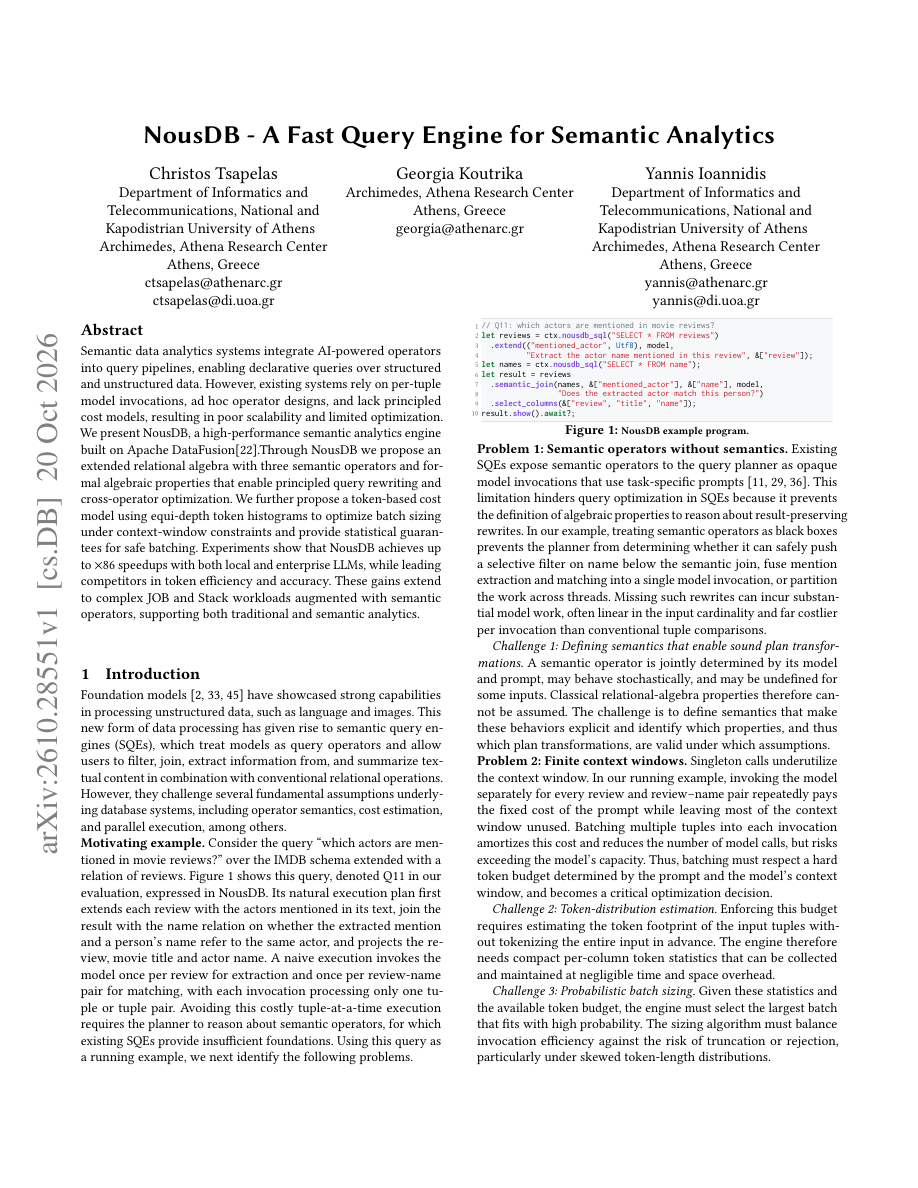
In the realm of data analytics, the ability to process and retrieve information effectively can make or break a system’s performance. The latest research introduces NousDB, a groundbreaking semantic analytics engine designed to significantly enhance the speed and efficiency of processing structured and unstructured data. Built on the robust Apache DataFusion framework, NousDB leverages advanced strategies to tackle common issues faced by traditional semantic query engines (SQEs) and provides a performance boost that can reach astonishing speeds, up to 86 times faster than competitors.
A New Era of Semantic Operators
NousDB redefines the standard for operational efficiency in query processing by integrating semantic operators into its core function. Unlike previous systems that rely heavily on per-tuple model invocations—which often result in sluggish performance and high computational costs—NousDB introduces an extended relational algebra featuring three semantic operators: Extend, Selection, and Join. These operators are designed to work closely with declarative queries, providing a more streamlined approach to data management.
Token-Based Cost Modeling: The Key to Efficiency
One of the standout features of NousDB is its token-based cost model, which shifts the focus from traditional row-based optimization to a more granular token management system. By using equi-depth token histograms, NousDB can optimize batch sizes effectively under context-window constraints, achieving substantial reductions in resource consumption while maintaining a high level of output accuracy.
This token-centric approach means that systems can run more complex queries without overwhelming the model’s limits, as it accounts for the maximum context window that each invocation can handle, thus optimizing both speed and output fidelity.
Experimental Evidence: NousDB Outperforms the Competition
In rigorous testing against previous systems such as LOTUS, Palimpzest, and Abacus, NousDB demonstrated remarkable efficiency across various benchmarks, including IMDB, SemBench, JOB, and STACK. The results showed that NousDB not only reduced token usage by significant margins (up to 19 times fewer tokens for complex queries) but also improved overall output quality, often reaching higher accuracy metrics than any of its competitors.
For example, on multiple queries, NousDB maintained an F1 score—an essential metric for evaluating the performance of information retrieval systems—demonstrating at least an 86% agreement with outputs generated through singular, non-batched processing strategies.
Real-World Applications and Future Prospects
As organizations increasingly rely on large datasets to inform decisions, tools like NousDB stand out for their ability to seamlessly integrate AI capabilities into standard query processing frameworks. Its architecture supports complex semantic analysis while offering the scalability needed to manage vast amounts of data efficiently.
Looking forward, the research team behind NousDB plans to extend its capabilities further by enhancing the semantic algebra with additional operators, improving the existing token-based cost model, and integrating more quality measures into their framework. This ambitious roadmap not only showcases NousDB’s potential to pioneer advancements in data analytics but also highlights the continuous evolution of technology in an era driven by data.


