
Revolutionizing Robotics: How ADADEX Unleashes Human-Like Dexterity from Just Seconds of Motion
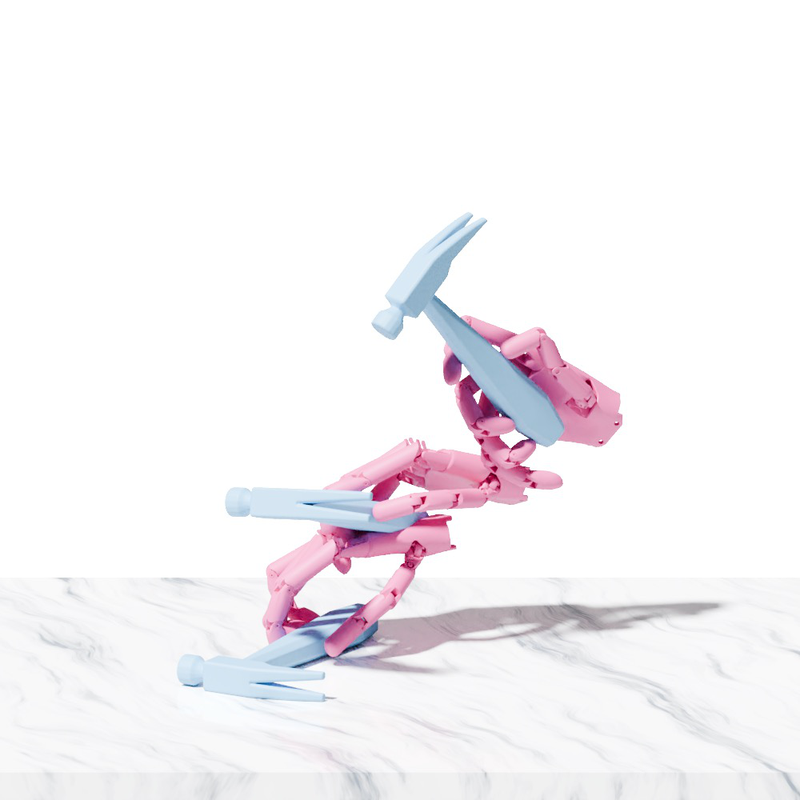
In a groundbreaking development, researchers from Carnegie Mellon University and NVIDIA have introduced ADADEX, a novel framework that teaches robots to master adaptable dexterous skills by learning from merely a few seconds of human motion. This innovative approach has the potential to significantly enhance robotic manipulation across various applications.
Hybrid Dexterous Mimicking: The Core of ADADEX
The heart of ADADEX lies in a unique method called Hybrid Dexterous Mimicking. Unlike traditional reinforcement learning methods, which often face challenges in generalizing skills, ADADEX integrates two learning paradigms: motion tracking and goal-reaching. This combination allows robots to replicate human-like dexterity while simultaneously adapting to new environments and tasks.
In simpler terms, ADADEX allows a robot to learn how to perform tasks—such as grasping a hammer or catching a ball—by watching a short video clip of a human doing the same. This means robots can learn quickly from limited data, making them more effective in unstructured environments where they encounter diverse objects and tasks.
Adapting to New Challenges
One of the standout features of ADADEX is its ability to adapt skills learned from one context to another, which is key for real-world applications. For instance, a robot trained to pick up a hammer can quickly learn to adjust its grip when tasked with using different types of tools or performing related actions, like throwing. This flexibility is essential in dynamic environments, akin to how humans adjust their techniques based on the situation.
Evaluating Performance and Real-World Applications
The results from extensive testing demonstrate that ADADEX significantly outperforms existing methodologies in both simulation and real-world scenarios. Robots utilizing ADADEX not only mimic human-like manipulation with high precision but also transfer their learned skills between different simulation environments and into real-world applications with remarkable accuracy.
From household chores to manufacturing tasks, the implications of ADADEX are vast. Future implementations could see robots assisting in domestic environments, performing tasks like pouring and sweeping, as well as participating in industrial processes that require sophisticated hand manipulations.
A Step Towards Intelligent Automation
As ADADEX pushes the boundaries of robotic capabilities, it represents a significant step toward intelligent automation. The framework paves the way for more intuitive and adaptable robots that understand and interact with their environment in ways previously thought impossible. This innovation not only enhances efficiency but also brings us closer to envisioning a future where robots seamlessly integrate into our daily lives.
With ADADEX, the potential for creating intelligent systems that can learn from humans in real-time has never been more tangible. As we move forward, the collaboration between robotics and advanced AI continues to hold exciting possibilities for the future.
Authors: Yuxuan Kuang, Jiashun Wang, Yixuan Sun, Yufei Ye, Sungjae Park, Umar Iqbal, Katerina Fragkiadaki, Shubham Tulsiani


