
Revolutionizing Long-Context Reasoning: How LONGZERO Enables LLMs to Learn without External Data
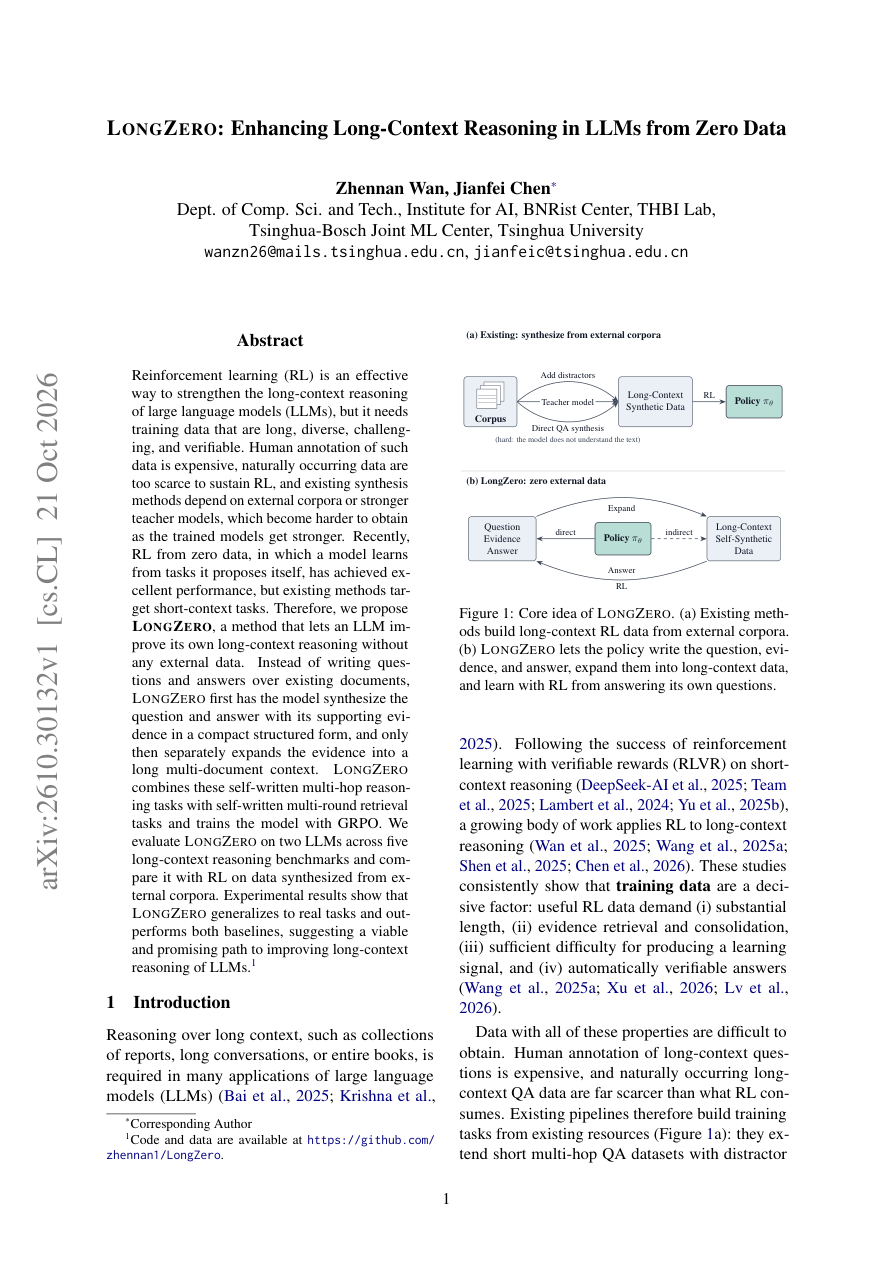
In the field of artificial intelligence, particularly with large language models (LLMs), a new breakthrough methodology called LONGZERO is setting the stage for how these models can enhance their reasoning capabilities over long contexts without relying on external data. Developed by researchers Zhennan Wan and Jianfei Chen from Tsinghua University, LONGZERO proposes an innovative approach to reinforcement learning (RL) that may redefine the way we train LLMs.
The Challenge of Long-Context Reasoning
Traditional reinforcement learning methods depend heavily on extensive datasets that include long, nuanced inputs to be effective. However, such datasets are often expensive to generate, rely on human annotations, or are simply not available in sufficient quantities. The scarcity of long context data limits the potential of LLMs in applications that require reasoning over long conversations, collections of reports, or entire books.
Moreover, existing methodologies often focus on short-context tasks, leaving a significant gap in training for more complex scenarios. This is where LONGZERO comes into play by shifting the paradigm. Instead of synthesizing long training data from existing external corpora, LONGZERO empowers the LLM itself to create its own queries, supporting evidence, and answers, thereby removed from the constraints of data reliance.
How Does LONGZERO Work?
LONGZERO introduces a two-step process for enhancing long-context reasoning. Initially, the LLM produces a structured format that includes a question and its corresponding answer alongside supporting evidence. This self-generated task breaks away from conventional methods that relied on extensive external context.
Once the model creates this compact structured task, it then expands its evidence into a longer multi-document context. This clever reverse-order generation effectively minimizes the risk of generating unreliable answers since the answer is already established before any long text is created.
Experimental Success
The efficacy of LONGZERO was tested across various benchmarks, illustrating its impressive ability to generalize to real-world tasks. The results showed that LONGZERO not only surpassed performance metrics established by previous methods but also achieved superior outcomes without the need for external data—a fundamental shift in how LLMs can be trained.
Specifically, LONGZERO demonstrated higher average scores across five long-context reasoning benchmarks, outpacing both baseline methods and the teacher-synthesized data that previously set the standard. This achievement underscores the model's capacity to adapt to more complex reasoning tasks while maintaining an internal consistency by generating its own data.
Future Implications
The advancements brought forth by LONGZERO have far-reaching implications for the training of LLMs. The ability to synthesize reliable long-context data internally positions researchers to push the boundaries of what these models can accomplish in practical applications—from chatbots and virtual assistants to automated research analysis and beyond.
As the research team continues to enhance LONGZERO, the future may see further integration of multi-round retrieval tasks, along with more complex question formulations. This pathway suggests a robust direction for future investigations aimed at optimizing LLM reasoning capabilities without relying on cumbersome data annotation processes.
With LONGZERO, the future of artificial intelligence in processing intricate, long-context information appears brighter than ever, marking a significant leap forward in the capacity for reasoning in machine learning models.


