
Revolutionizing Logic and Planning: How Binary Discrete Diffusion is Shaping AI's Future
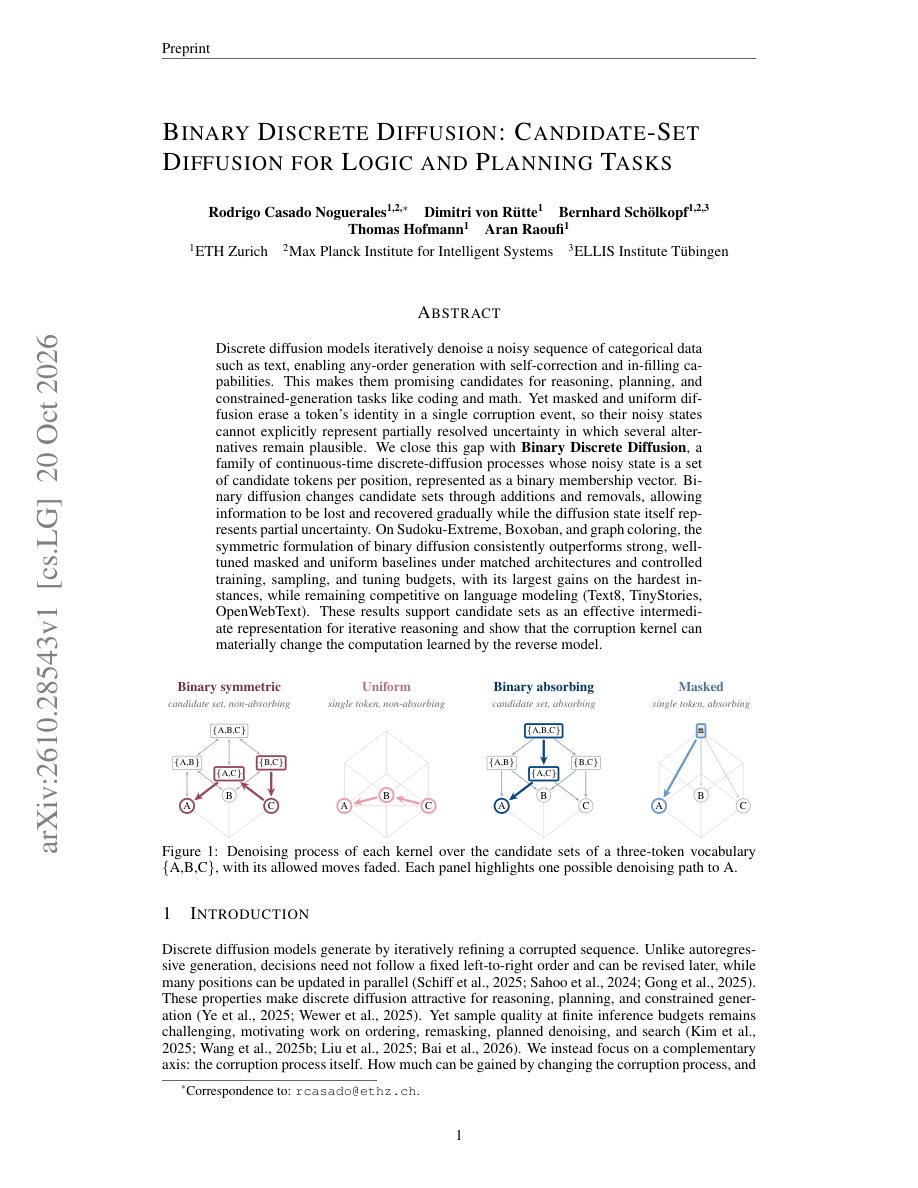
A groundbreaking research paper titled "Binary Discrete Diffusion: Candidate-Set Diffusion for Logic and Planning Tasks" introduces an innovative approach to AI problem-solving that could change how we tackle reasoning and planning challenges. Authored by a team from renowned institutions including ETH Zurich and the Max Planck Institute for Intelligent Systems, this research unveils a method called Binary Discrete Diffusion that outperforms traditional techniques in specific tasks such as Sudoku, Boxoban, and graph coloring.
The Essence of Binary Discrete Diffusion
Discrete diffusion models have gained traction for their ability to refine sequences of categorical data, such as text, gradually improving the quality of generated outputs. The primary challenge, however, lies in the corruption process, where information about the original state can be lost through masking or uniform approaches. Binary Discrete Diffusion addresses this by representing each position not as a single token but as a set of candidate tokens. This allows for a more nuanced handling of uncertainty, enabling the model to maintain multiple plausible alternatives at once, which is especially useful in tasks with inherent ambiguity.
Breaking Down the Mechanics
The innovation lies in transforming the state of the model into a binary membership vector, which can dynamically add or remove candidates as the model processes information. This step allows the model to reflect a state of uncertainty, unlike traditional masking techniques that lock a position in a single token once corrupted.
Binary Symmetric Diffusion, a variant showcased in this study, methodically allows bits in the candidate sets to switch on and off, providing a continuous flow of potential solutions. This iterative refinement results in models that aren't only faster but also more efficient in solving complex logic problems.
Impressive Results and Applications
In rigorous testing, Binary Symmetric Diffusion outshone other established methods on tasks designed to assess logical reasoning capabilities, particularly in challenging instances. For example, when applied to Sudoku-Extreme, this new diffusion model demonstrated a significant lead in solving rates compared to its counterparts, especially in complex puzzles that offer fewer clues.
Broader Implications and Future Directions
This groundwork sets the stage for exciting developments in AI reasoning capabilities. The versatility of candidate sets opens up avenues for refining tasks beyond logic puzzles, potentially enhancing AI's ability to perform in coding, mathematics, and even creative pursuits. The research paves the way for future kernels that might explore deeper semantic or task-specific structures, heralding a new era of intelligent AI capable of tackling multifaceted problems much more adeptly.
Overall, this exploration into Binary Discrete Diffusion marks a significant milestone in the evolution of AI planning and reasoning, suggesting that embracing uncertainty in model states could unlock hidden potentials in the machinery of artificial intelligence.
Authors: {Rodrigo Casado Noguerales, Dimitri von Rütte, Bernhard Schölkopf, Thomas Hofmann, Aran Raoufi}


