
Revolutionizing Legal Review: The Delayed Countdown Method Transforms eDiscovery Workflows
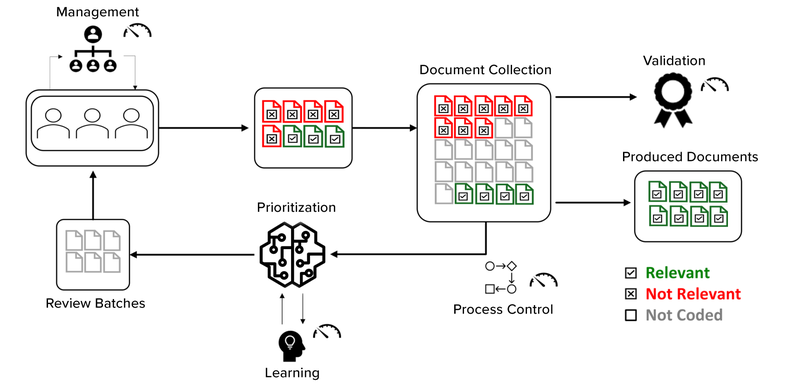
In the complex world of electronic discovery (eDiscovery), where the stakes of legal documentation and evidence are incredibly high, a recent paper introduces a groundbreaking approach known as the Delayed Countdown method. By tackling the long-standing issue of validating efficiency in AI-assisted document reviews, this method promises to streamline workflows and enhance accuracy in assessment, making it a vital asset for legal professionals.
Understanding eDiscovery and the Need for Validation
eDiscovery involves the identification, collection, and review of electronic documents as part of litigation or regulatory compliance. Traditionally, the effectiveness of document review workflows—specifically those relying on AI and machine learning—has been unclear and contentious. The challenge lies in determining whether the coding decisions made by reviewers can be trusted for validation purposes.
Existing methods have led to confusion, primarily due to different assumptions about the accuracy of coding and how it impacts the production of relevant documents. The Delayed Countdown method emerges as a practical solution to these challenges, integrating seamlessly into current workflows and providing clear validation metrics for legal teams to utilize.
The Delayed Countdown Method Explained
The Delayed Countdown method offers a straightforward evaluation of review-oriented workflows. It combines the strengths of existing methodologies—namely, countdown and elusion approaches—to deliver reliable statistical estimates of process effectiveness. Here’s how it works:
- Initial Review: After a segment of documents has been reviewed, a random sample is drawn from the unreviewed documents to assess their relevance.
- Transformation of Estimates: Instead of merely estimating based on the sample, the method transforms this data into an estimate of the total number of relevant documents in the entire collection.
- Iterative Validation: As the review progresses, estimates are continuously updated, allowing for real-time assessments of effectiveness without the risk of 'p-hacking,' where results are manipulated to report favorable outcomes.
The Benefits of the New Approach
The introduction of the Delayed Countdown method brings several key advantages:
- Clarity and Confidence: It removes ambiguities by establishing clearer assumptions about coding accuracy, leading to greater confidence in statistical outputs.
- Flexibility in Review Management: The method accommodates various stopping rules without compromising the validity of confidence intervals, allowing teams to adapt to the needs of their review process.
- Cost Reduction: By optimizing sample size and timing, this method has the potential to lower overall review costs, making eDiscovery more efficient.
Looking Ahead: The Future of AI in Legal Reviews
The Delayed Countdown method is not just a theoretical construct; it is a practical, adaptable framework ready for implementation in legal practices today. Its ability to provide reliable estimates during the review process essentially redefines how legal teams can validate the effectiveness of their AI-assisted workflows. As AI continues to evolve, methods like this will play an essential role in maintaining accuracy and trust in legal proceedings.
As legal professionals navigate the complexities of eDiscovery, the Delayed Countdown method stands out as a beacon of innovation, facilitating smarter, more efficient, and more trustworthy document reviews.
Authors: David D. Lewis, Tara Emory, Lenora Gray, Mark Noel, Jeremy Pickens, Eugene Yang


