
Revolutionizing Legal AI: How System One Decision Models Outperform Generative LLMs in Legal Citation Verification
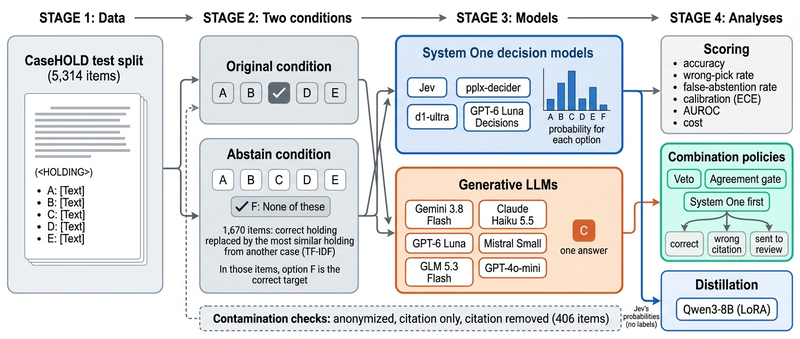
The rise of Artificial Intelligence in legal practice has introduced both opportunities and challenges. A groundbreaking research paper by M. Mikail Demir at the University at Albany explores the efficacy of System One decision models compared to large language models (LLMs) in the context of legal citation verification. This research comes at a critical time when legal AI tools face scrutiny for their reliability and accuracy.
The Challenge of Legal Citation
Legal professionals often rely on various AI systems to assist with research, but the instances of incorrect citations have sparked significant concern within the judicial system. These "hallucinated" citations—where AI generates references that do not exist or misrepresent the law—have led to sanctions against legal professionals, putting additional strain on already overburdened courts.
For instance, courts have reported numerous errors where AI tools misstated legal holdings, highlighting the need for systems that not only provide accurate citations but also recognize when no citation is suitable.
Understanding System One Decision Models
Demir’s study introduces System One decision models, designed to tackle the specific challenges of legal citation. Unlike generative LLMs that produce text outputs, these decision models return a calibrated probability for each option presented. This means they evaluate scenarios and provide a "commit or abstain" response—essentially deciding whether to cite an authority or admit uncertainty when no appropriate authority exists.
A Comparative Analysis
The research utilized a dataset known as CaseHOLD, enhancing it by introducing an abstention condition to assess how models behave when the correct holding is absent. The results revealed a striking difference: while generative LLMs frequently selected incorrect citations—often choosing one even when it was not applicable—System One models demonstrated significantly greater caution. Specifically, the most cautious decision model selected an incorrect holding in only 30% of cases, compared to as high as 86% for generative LLMs.
Significance of Caution in Legal Settings
One of the key findings posited by Demir is that accuracy alone is not the best measure of a legal AI tool’s reliability. The penalty for a wrong citation can be steep, leading to sanctions against legal professionals and potential impacts on cases. Demir suggests that legal AI should be evaluated on how often it cites incorrectly alongside its accuracy.
Moreover, by implementing a strategy where decision models are used to vet generative LLM outputs, legal professionals can reduce the likelihood of erroneous citations by half, showcasing a blended approach that leverages the strengths of both systems.
Looking Ahead
This research emphasizes the importance of developing AI systems that are not only accurate but also understand the implications of misjudging legal citations. By fostering a technology-driven dialogue around legal authority, decision models like the System One can significantly enhance the integrity of legal AI tools while alleviating the burdens on the judicial system.
As legal AI continues to evolve, understanding the boundaries of these technologies will be paramount. The future of legal practice may well depend on systems that strive for honesty and clarity, mirroring Abraham Lincoln's timeless advice to "resolve to be honest at all events."
For further insights, the research paper and additional methodologies can be accessed through its GitHub repository.


